Your customer sees a YouTube pre-roll on Monday, searches your brand on Google Tuesday, scrolls past a retargeting ad on Instagram Wednesday, and finally converts from an email on Friday. That's one person, one decision, and five separate ad accounts that have no idea the other four exist. Cross-channel advertising is the practice of making those channels talk to each other, so your budget, messaging, and measurement work as one campaign instead of five disconnected ones. This guide covers what cross-channel advertising is, how it differs from multichannel and omnichannel, why it matters, and how to build a campaign that treats the customer journey as a single path.
What is cross-channel advertising?
Cross-channel advertising is a coordinated approach that runs consistent messaging and shared audience data across multiple advertising channels, so each channel reinforces the others toward one goal. Instead of managing search, social, display, and connected TV as isolated campaigns, you connect them: a person who saw your video ad gets a different search message than a cold prospect, and budget can shift toward channels with stronger recent performance, within guardrails.
The word doing the heavy lifting is coordinated. Running ads on five platforms isn't cross-channel advertising by itself; coordination is what turns five parallel campaigns into one strategy, where a touch on one channel informs the next. A retail brand might use connected TV to build awareness, paid search to capture the resulting demand, and email to close, with each stage aware of the last. That handoff between channels is the whole idea.
How does cross-channel advertising work?
Cross-channel advertising works by wiring five things together that most teams run separately: data, audiences, creative, delivery, and measurement. Share a common backbone across those five and coordination becomes possible; keep them siloed, and you're back to parallel campaigns that happen to share a logo.
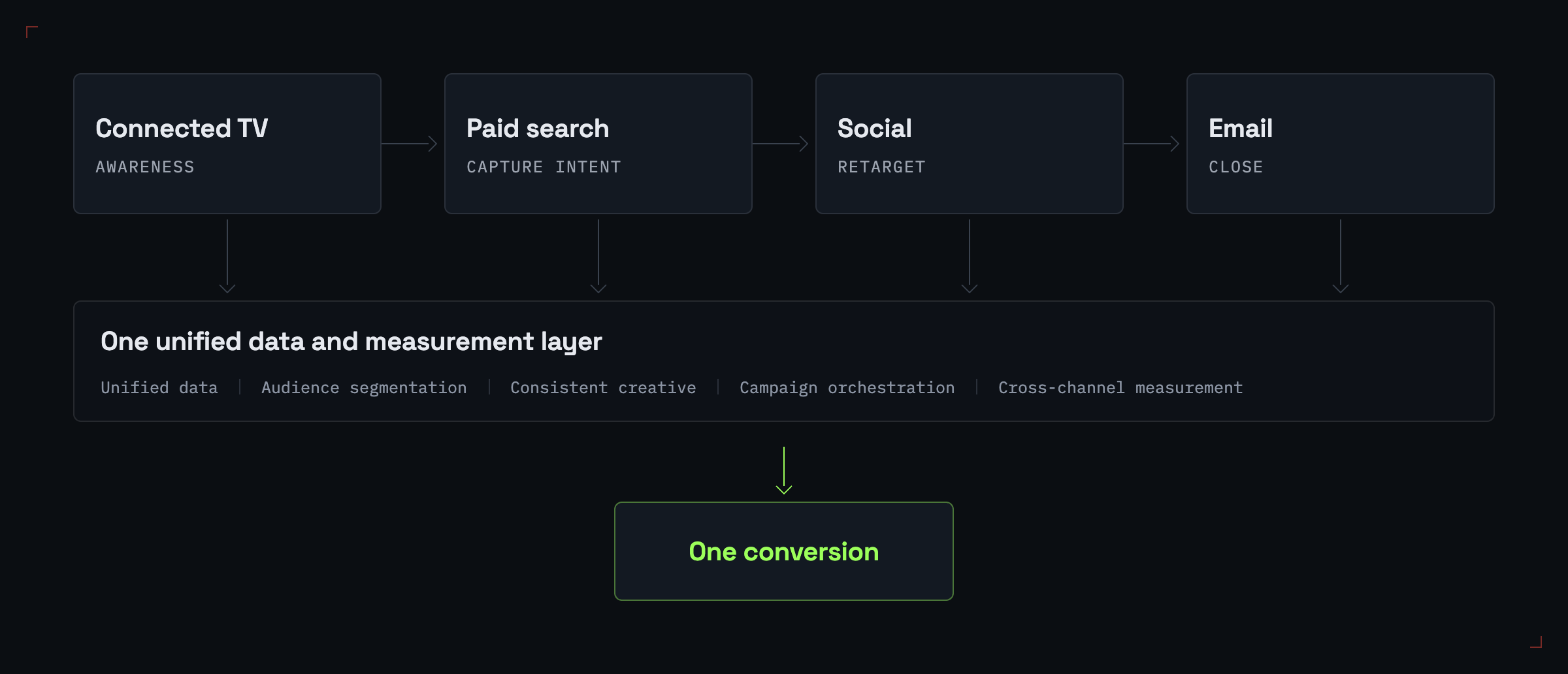
Here's what each piece does in practice:
- Unified data. Available data from connected platforms lands in one view, so you can see who's engaging rather than a separate report per channel.
- Audience segmentation. Those shared audiences get built once and pushed out where platform integrations and privacy rules allow. A "viewed product, didn't buy" segment can be suppressed on prospecting campaigns and targeted on retargeting ones, across channels.
- Consistent creative. The message and visual identity stay coherent as a person moves between YouTube, a display banner, and their inbox, while adapting to each format's constraints.
- Campaign orchestration. Delivery is sequenced: awareness before the hard-sell retargeting ad, with cross-channel frequency management, where supported, so one person doesn't see the same ad forty times.
- Cross-channel measurement. Conversions are attributed across every touchpoint, not credited entirely to the last click, so you can see which channels likely contributed to the outcome. Attribution assigns credit; proving causality still takes holdout tests, geo experiments, incrementality testing, or other controlled experiments.
The connective tissue is data. Google and Meta don't share their native learning systems directly, but teams coordinate across them through first-party audiences, conversion imports, CRM data, or a third-party operator layer, so a decision shaped by Meta performance can inform targeting on Google. When that coordination doesn't happen, every channel optimizes in its own bubble, and you stitch the story together in a spreadsheet after the money's spent.
Cross-channel vs. multichannel vs. omnichannel advertising
These three terms get used interchangeably, and they shouldn't be. The difference comes down to how connected the channels are.
| Approach | Channel relationship | What the customer experiences | Example |
|---|---|---|---|
| Multichannel | Present on many channels, run in silos | Consistent brand, but each channel acts alone and doesn't know what the others did | Search, social, and display campaigns launched separately, each with its own budget and reporting |
| Cross-channel | Channels connected and coordinated around one goal | A message that builds across channels, informed by prior touchpoints | A video view triggers a tailored search and email follow-up; budget shifts to the best-performing channel |
| Omnichannel | Unified, near-real-time experience where systems are integrated end to end | A single continuous experience across ads, site, app, support, and in-store | A cart abandoned on mobile surfaces as an ad, an email, and a synced in-store offer, in near real time where systems are integrated |
Multichannel is about presence, cross-channel is about coordination, and omnichannel is about a unified experience. Multichannel means you show up in a lot of places; cross-channel means those places share data and talk to each other. Omnichannel goes further, folding every customer touchpoint (not just advertising but the website, app, support, and stores) into one continuous experience.
For most advertising teams, cross-channel is the practical target. True omnichannel requires deep integration across systems many organizations don't have yet, while cross-channel advertising delivers most of the coordination benefit by connecting the ad channels you already run. It's the achievable middle ground between scattered multichannel campaigns and the omnichannel ideal.
Why cross-channel advertising matters
The case for cross-channel advertising isn't abstract; it shows up in four places that directly affect performance.
Consistent messaging builds trust and recall. When a prospect sees a coherent story across channels instead of contradictory pitches, the brand tends to register faster, and conversions tend to get cheaper. Fragmented messaging wastes the awareness you paid to build. Three more benefits are worth stating plainly:
- Better engagement. Meeting people on their preferred channels, with a message that reflects where they are in the journey, beats blasting the same ad everywhere.
- Smarter ad spend. When budget can move toward whatever's converting, you stop overspending on a tapped-out channel and starving a hot one. This is the efficiency lever most single-channel setups can't pull.
- Cleaner measurement. Coordinated tracking across touchpoints shows which channels likely contribute, so you invest based on a clearer read of return instead of last-click bias.
There's a reason this is hard to pull off, though, and it's worth being candid about it. McKinsey found that "nearly 90 percent of CMOs are experimenting with AI use cases across various points of the marketing process, but less than 10 percent have captured value across end-to-end workflows." The pattern behind that gap is fragmentation: point tools bolted onto disconnected channels don't add up to a coordinated strategy. Cross-channel advertising matters precisely because unifying the channels is usually what turns activity into results.
Channels in a cross-channel advertising strategy
A cross-channel strategy can pull from any mix of paid surfaces. The point isn't to be everywhere; it's to pick the channels your audience actually uses and connect them. The common building blocks:
- Paid search. Captures active intent when someone is already looking. Usually the closer in a cross-channel sequence.
- Paid social. Facebook, Instagram, LinkedIn, TikTok, Reddit, and the rest. Strong for prospecting, retargeting, and reaching people by interest and behavior.
- Display and the open web. Banner and native inventory across sites. Cheap reach for awareness and retargeting, though it needs frequency discipline.
- Online video and connected TV. YouTube and streaming inventory. Connected TV brings TV-style storytelling with digital targeting, which is why it has become a common awareness channel in cross-channel plans.
- Retail media. Ad space on retailers like Amazon and Walmart, close to the point of purchase, with first-party shopper data.
- Email and SMS. Owned channels that anchor the sequence. They have low marginal cost relative to paid media and convert well, which makes them the backbone many cross-channel journeys build around.
You don't need all of them. A B2B team might run LinkedIn, search, and email; a DTC brand might lean on paid social, connected TV, and retail media. What makes it cross-channel isn't the count, but whether the channels share data and coordinate rather than just running side by side.
How to build a cross-channel advertising campaign
Building a cross-channel campaign is less about adding channels than connecting the ones you have. A practical sequence:
- Start with one goal. Pick a single objective (a target cost per acquisition, a revenue number, a lead volume) that every channel optimizes toward. Coordination falls apart if each channel chases a different metric.
- Unify your data. Pull campaign and customer data into one view so decisions on one channel can use what's happening on another. This is the foundation everything else stands on.
- Segment audiences once, use them everywhere. Build core segments (prospects, engaged, existing customers) and push them across platforms so you can suppress, target, and sequence consistently.
- Orchestrate the sequence. Decide the order. Awareness before conversion, and manage frequency across channels, where platforms support it, so a single person isn't hammered with the same ad on every surface.
- Automate delivery with guardrails. Let bidding and budget shifts run continuously within limits you set, rather than waiting for a weekly manual review.
- Measure across touchpoints and optimize. Use attribution that credits the full journey instead of only the last click, then feed the results back into where budget goes next.
The hardest step is usually the second one. Unifying data across platforms that each have their own API, metrics, and login is where most cross-channel ambitions stall, which is exactly the problem the next section is about.
Common challenges (and how to solve them)
Cross-channel advertising is simple in theory and hard in practice. Five pain points come up again and again.
Data silos are the root problem. Every platform is its own walled garden with its own dashboard, metrics, and export format. A single view of the customer means reconciling data that was never designed to fit together. The fix is a layer that pulls campaign and audience data into one place, so you're not exporting spreadsheets from ten tools.
The other four challenges are familiar to anyone who's run this:
- Audience overlap and frequency fatigue. Without frequency management across channels, the same person can get bombarded across every surface, which annoys them and wastes spend. Coordinated delivery, where platforms support it, helps control this.
- Inconsistent creative. When each channel is managed by a different person or tool, the message drifts. A shared creative source keeps it coherent.
- Last-click attribution bias. Crediting only the final touch starves the upper-funnel channels that often created the demand. Multi-touch attribution helps correct the picture.
- Managing many platforms. Ten dashboards, ten bidding logics, ten places to check. The operational overhead alone can stop small teams from ever getting to true coordination.
That last challenge is where the tooling landscape is shifting, as a newer category of platforms tries to collapse the ten-dashboard problem into one control surface. Synter, our own product, is one example: an AI agent operator that gives you a unified interface across 16 ad platforms through a single layer built on the Model Context Protocol plus a REST API, so you manage Google, Meta, LinkedIn, TikTok, and the rest from one place. Our agents can run automated cross-channel budget optimization (adjusting bids on live performance, pausing underperformers, and shifting budget across platforms by return) and feed multi-touch attribution back into the loop so measurement isn't an afterthought. It's one option among several and worth evaluating on your own accounts, but it illustrates the direction: unify the channels first, then coordinate them. Even with an operator layer in place, teams still need clean tracking, budget guardrails, creative QA, and human approval thresholds for major spend moves.
Frequently Asked Questions
What's the difference between cross-channel and omnichannel advertising? Cross-channel advertising connects and coordinates your ad channels around one goal, sharing data and messaging between them. Omnichannel goes further by unifying every customer touchpoint (ads, website, app, support, and in-store) into a near-real-time, integrated experience. Cross-channel is about coordinating advertising; omnichannel is about one continuous experience across the whole business.
What's the difference between cross-channel advertising and cross-channel marketing? They overlap heavily and get used interchangeably. Cross-channel advertising specifically means coordinating paid media (search, social, display, CTV, retail media) across channels. Cross-channel marketing is the broader term that also covers owned and earned channels like organic content, email, and PR. Advertising is the paid subset of the wider marketing effort.
What's an example of cross-channel advertising? A streaming brand runs a connected TV ad to build awareness, then targets viewers with paid search when they look up the brand, retargets non-converters on Instagram, and closes with an email offer. Each channel knows what the previous one did, budget shifts toward channels with stronger recent performance, and frequency is managed so no one is overwhelmed. That coordination across paid channels is cross-channel advertising in action.
Conclusion
Cross-channel advertising is the difference between running ads in a lot of places and running one coordinated campaign that treats the customer journey as a single path. The core ideas are consistent: unify your data, coordinate your channels around one goal, and measure across the whole journey instead of crediting the last click. Multichannel gets you presence, omnichannel is the fully unified ideal, and cross-channel is the practical target most advertising teams should aim for right now.
If the overhead of managing many platforms is what's holding you back, that's the problem worth solving first. Review the current plans to see what running coordinated cross-channel campaigns from one interface looks like. Start by picking a single goal and connecting two channels around it, then expand from there.