The Definitive Guide
Growth Marketing
in the Age of AI Agents
The playbook for performance marketers who want to scale their output without scaling the headcount.
AI agents are changing how marketing gets done. Not "someday"—right now. The marketers who figure this out first will gain unfair advantage. This guide shows you how.
Everything here works with Claude, ChatGPT, Synter, or any AI assistant with access to your data. The principles are what matter.
The New Paradigm
Why everything is about to change
For the past decade, performance marketing has been a game of who can hire more specialists, build more dashboards, and process more data. That era is ending.
AI agents—systems that can take actions, not just generate text—are collapsing the time between insight and execution from days to seconds. The marketer who can direct an AI agent effectively now has the output capacity of an entire team of specialists.
What "Agentic" Actually Means
An AI agent isn't just a chatbot. It's an AI system that can:
- →Access your data — Pull reports from ad platforms, read your CRM, analyze your analytics
- →Take actions — Create campaigns, adjust bids, pause underperformers, generate creative
- →Chain tasks together — "Analyze performance → identify issues → fix them → report back"
- →Learn your context — Understand your goals, brand voice, historical performance, and constraints
- →Always on — Works around the clock for you, never gets tired, never goes off-shift, never makes manual data entry mistakes
The Shift in Your Role
Your job as a marketer is no longer to do the work. It's to direct the work. You're moving from operator to strategist. From executor to architect.
What You Stop Doing
- • Manually pulling reports from 5 platforms
- • Copy-pasting data into spreadsheets
- • Writing the same ad copy variations
- • Checking campaign budgets daily
- • Building slide decks from scratch
- • Hunting for optimization opportunities
What You Focus On
- • Setting strategy and goals
- • Asking the right questions
- • Reviewing and approving AI work
- • Making judgment calls AI can't
- • Understanding customer insights
- • Connecting marketing to business outcomes
The Uncomfortable Truth
Marketers who spend their days on execution tasks are going to be replaced—not by AI directly, but by marketers who know how to use AI. One person with the right AI workflow will outperform a team that's still doing things manually. This guide is about how you become a leader in the first group.
The Right Mental Model
How to think about working with AI agents
Most people use AI wrong. They treat it like a search engine—ask a question, get an answer. That's leaving 90% of the value on the table.
Think: Experienced Employee on Day One
The best mental model: AI is like a seasoned marketer who just joined your company today. They have deep expertise but zero context about your specific situation. Your job is to onboard them.
Context is Everything
The more context you provide, the better the output. Share your goals, constraints, history, and preferences upfront.
For example — Generic task: 'Write some Google Ads headlines.' Specific task: 'Write headlines for our B2B SaaS product targeting CFOs. Our main differentiator is we're 50% cheaper than competitors. Past winners have focused on cost savings. Avoid jargon.'
Iterate, Don't One-Shot
Complex work happens through conversation, not single prompts. Plan to go back and forth.
For example — Start with 'Analyze my Google Ads account' → then 'Dig deeper on the search campaigns' → then 'What's causing the high CPA in the brand campaign?'
Show, Don't Just Tell
When possible, give examples of what good looks like. AI learns your preferences through demonstration.
For example — 'Here's a creative brief that worked well for us: [example]. Create a similar one for our new product launch.'
Verify Before Trusting
AI is confident even when wrong. Always verify important outputs, especially numbers and specific claims.
For example — If AI says your CPA is $45, spot-check it against the platform. If it recommends pausing a campaign, understand why first.
The Prompt Quality Spectrum
Better inputs = dramatically better outputs
"How are my ads doing?"
→ Generic advice, surface-level analysis
"Analyze my Google Ads performance for the last 30 days"
→ Platform-specific analysis with actual data
"Analyze my Google Ads performance for the last 30 days. Focus on search campaigns. Our target CPA is $50 and we're trying to scale spend while maintaining efficiency."
→ Targeted analysis aligned with your goals
"Analyze my Google Ads search campaigns for the last 30 days. We sell B2B software with a $50 target CPA. We increased budget 20% last week. I'm seeing CPAs rise and want to understand why and what to do about it. Show me the data and give me specific recommendations I can implement today."
→ Actionable insights with implementation plan
What You'll Learn
Now that you understand the new paradigm and the right mental model, here's what we'll cover in the sections ahead:
What You'll Put in Place
Data foundation, tracking infrastructure
What You'll Plan
Media planning, competitive intelligence, audience strategy
What You'll Build
Creative development, campaign building, automation
What You'll Focus On
Optimization, attribution, reporting, forecasting
How You'll Work
Daily & weekly workflows, account audits, team processes
How You'll Connect to Revenue
Business impact and proving marketing's value
Building Your Data Foundation
Connect everything to unlock full potential
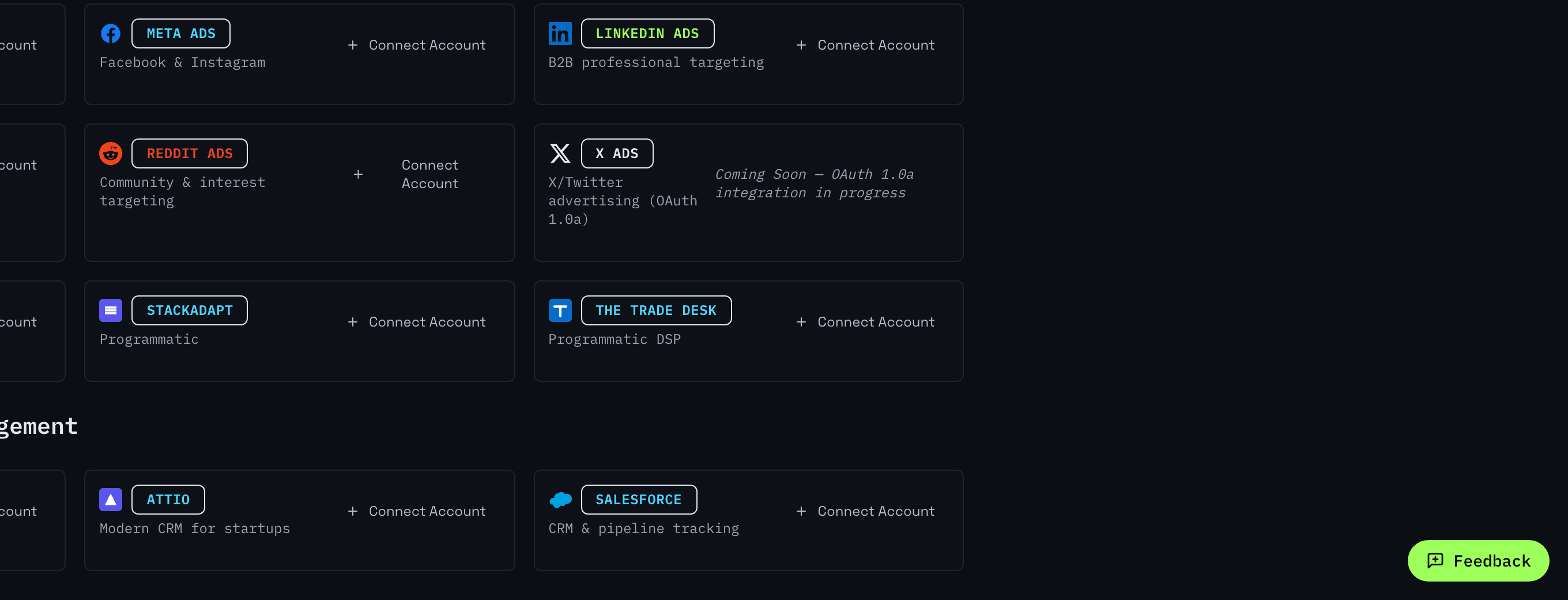
An AI agent relies upon the data it can access. To get the best results, connect all your data sources so the AI can see the full picture.
The Data Stack for Modern Marketing
Ad Platforms
Where you spend money
Campaign data, performance metrics, audience insights, creative performance
Tag Management & Tracking
What connects everything
Accurate tracking, first-party data collection, cross-platform attribution, privacy compliance
Web & Product Analytics
What happens after the click
User behavior, conversion funnels, engagement metrics, feature adoption, session recordings
CRM & Revenue
What turns into money
Lead quality, pipeline data, closed revenue, customer lifetime value, sales cycle length
Marketing Automation
What nurtures your contacts
Email performance, nurture effectiveness, lifecycle stage, engagement scoring
Competitive Intelligence
What others are doing
Competitor spend, keywords, ad creative, market share, share of voice
Attribution & MMM
What impact you're having
Cross-channel attribution, incrementality, media mix modeling, true ROAS
Business & Revenue Intelligence
What results you're achieving
Revenue metrics, churn analysis, customer health, sales intelligence, deal insights
Minimum Viable Stack
If you can only connect three things, make them:
- 1.Your main ad platform — Where most of your spend goes
- 2.Google Analytics — What happens on your site
- 3.Your CRM — What converts to revenue (if B2B)
How to Connect Your Data
There are several ways to give AI access to your marketing data:
Manual Export
Export CSVs and paste/upload them
Works with any AI. Tedious but universal.
API Connections
Direct platform integrations
Real-time data. Requires setup. Best experience.
Data Warehouse
BigQuery, Snowflake, etc.
For mature teams. Unified data layer.
Screen Sharing / Screenshots
Show the AI what you're looking at
Quick and dirty. Good for one-off analysis.
Tracking Infrastructure
The foundation everything else depends on
Bad tracking = bad decisions. Before you optimize anything, make sure you're measuring correctly. This is the tedious foundation that separates amateurs from professionals. You'll need all four of these components working together.
The Modern Tracking Stack
Tag Management
Google Tag Manager, Segment, Tealium
Central control for all your tracking pixels and scripts. Never hardcode tags again.
Server-Side Tracking
GTM Server-Side, Segment Connections
Bypass ad blockers, improve data quality, maintain privacy compliance.
Conversion APIs
Meta CAPI, Google Enhanced Conversions, LinkedIn CAPI
First-party data sent directly to platforms. Essential in a post-cookie world.
Analytics
GA4, Mixpanel, Amplitude, PostHog
Understand user behavior, build funnels, analyze conversion paths.
Tracking Audit Prompts
Full Tracking Audit
"Audit our tracking setup. Check: Are all key conversion events firing correctly? Is there data discrepancy between platforms (GA4 vs Google Ads vs Meta)? Are we using enhanced conversions / CAPI? What's our match rate? What tracking gaps exist?"
GA4 Setup Review
"Review our GA4 implementation. Are we tracking all important events? Is e-commerce tracking set up correctly? Are conversions importing to Google Ads? What custom dimensions should we add? Are there any data quality issues?"
Conversion API Health Check
"Check the health of our Conversion API implementations. What's our event match quality on Meta? Are we sending all required parameters? Is deduplication working correctly? What's the discrepancy between pixel and CAPI events?"
Cross-Platform Discrepancy Analysis
"I'm seeing different conversion numbers across platforms. GA4 shows [X], Google Ads shows [Y], Meta shows [Z]. Help me understand why these numbers differ and which is closest to truth."
What to Track
| Business Type | Primary Events | Secondary Events |
|---|---|---|
| B2B SaaS | Demo request, Trial start, Qualified lead | Pricing view, Feature page, Case study download |
| E-commerce | Purchase, Add to cart, Begin checkout | Product view, Add to wishlist, Collection view |
| Lead Gen | Form submit, Phone call, Chat initiated | Quote request, Location lookup, Service page view |
| Mobile App | Install, In-app purchase, Subscription start | Registration, Tutorial complete, Feature unlock |
| Content/Media | Subscription, Newsletter signup, Account create | Article read (scroll depth), Video watch, Share |
The 2024+ Reality: First-Party Data is Everything
With cookie deprecation and iOS privacy changes, third-party tracking is dying. If you're not sending first-party data via Conversion APIs, your platform optimization is degraded. This isn't optional anymore—it's table stakes for accurate attribution and efficient bidding.
Media Planning
Build plans grounded in data, not guesswork
A media plan is your blueprint: where to spend, how much, and why. AI can help you build plans based on historical performance, market benchmarks, and your specific goals—not just intuition.
The Components of a Media Plan
Budget Allocation
How much goes to each channel based on historical efficiency and scale potential
Channel Strategy
Which platforms to use and what role each plays in the funnel
Audience Strategy
Who you're targeting and how targeting differs by channel
Timeline & Pacing
How spend distributes across weeks/months and key milestones
KPIs & Targets
What success looks like at each level—channel, campaign, and overall
Creative Requirements
What assets you need and when you need them
Prompts for Media Planning
Building a Plan from Scratch
"I need a media plan for [Q/time period]. Budget: [$X]. Goal: [Y conversions/leads/sales]. Our current cost per [conversion] is [$Z]. We've historically spent on [channels]. Help me build a plan that allocates budget optimally based on channel efficiency, accounts for seasonal trends, and gives us the best chance of hitting our goal."
Analyzing Historical Performance First
"Before I plan next quarter, analyze our performance this quarter across all channels. Show me: which channels are most efficient, where we have room to scale, where we're wasting money, and what trends I should account for in planning."
Budget Reallocation
"I have $50K/month to allocate across Google, Meta, and LinkedIn. Based on our last 90 days of performance, what's the optimal split? Show me your reasoning and what results I should expect from each channel."
New Channel Evaluation
"We're considering adding [TikTok/Reddit/Programmatic] to our mix. Based on our target audience, current performance benchmarks, and goals, does this make sense? What budget should we test with and what would success look like?"
Pro Tip: Challenge the Plan
After generating a media plan, ask: "What are the biggest risks in this plan? What assumptions am I making that might be wrong? What would cause this plan to fail?" AI is good at optimistic planning—make it think critically too.
Competitive Intelligence
Know what you're up against
Understanding your competitive landscape helps you position better, find gaps, and learn from what's working in your market. AI can synthesize competitive data into actionable insights.
What You Can Learn
Paid Search Strategy
Keywords they bid on, estimated spend, ad copy themes
Social Ad Creative
What ads they're running, messaging angles, offers
Market Positioning
How they describe themselves, who they target
Landing Pages
How they convert traffic, offers, page structure
Prompts for Competitive Analysis
Competitor Deep Dive
"Analyze [competitor.com] as a competitor. I want to understand: their estimated ad spend, top keywords they're bidding on, main messaging themes in their ads, and how they position against us. Include specific examples where possible."
Market Overview
"Who are the top advertisers in the [industry/category] space? What's the competitive landscape look like in terms of spend levels, common strategies, and messaging themes? Where are the gaps we might exploit?"
Head-to-Head Analysis
"Compare our paid search strategy to [competitor]. Where are we winning? Where are they beating us? Are there keywords they're targeting that we're missing? What can we learn from their approach?"
Ad Creative Analysis
"Look at [competitor]'s ads in Meta Ad Library. What messaging angles are they using? What offers? What creative formats? Identify 3 things we could test based on what seems to be working for them."
Important: Competitive data is estimated and directional. Use it to inform strategy, not as precise numbers. Trends and relative comparisons matter more than absolute figures.
Audience Strategy
Reaching the right people matters more than anything
Audience is the biggest lever in performance marketing. A mediocre ad to the right audience beats a great ad to the wrong audience every time. AI can help you define, build, and refine your audiences across channels.
Audience Development Framework
Define Your ICP
Start with your ideal customer profile. Who are they? What do they care about? What problems do they have that you solve?
"Help me define our ideal customer profile for [product]. We sell to [general description]. Our best customers tend to be [characteristics]. What questions should I answer to sharpen this?"
Map to Platform Targeting
Translate your ICP into the targeting options each platform offers.
"Our ICP is [description]. How do I translate this into targeting on Google, Meta, and LinkedIn? What targeting options should I use on each platform? Where will there be gaps?"
Build Audience Segments
Create distinct segments based on awareness level, intent, and relationship with your brand.
"Help me build an audience segmentation for our paid campaigns. I want segments for: cold prospects, warm audiences who've engaged, retargeting audiences, and existing customers. For each, describe who they are and what targeting I should use."
Test and Learn
Run structured tests to find which audiences perform best.
"I want to test 3-4 audience segments on Meta. Help me design the test: what audiences to test, how to structure campaigns, what budget per audience, and how long to run before making decisions."
Audience Analysis Prompts
Performance by Audience
"Analyze my campaign performance by audience segment. Which audiences have the best CPA? Highest conversion rate? Best ROAS? Where am I wasting spend on audiences that don't convert?"
Audience Expansion
"Our best performing audience is [description]. How can I expand reach while maintaining quality? What lookalike strategies should I test? What adjacent audiences might work?"
Creative Development
From briefs to assets
Creative is where AI multiplies your output. What used to take a team of copywriters and designers now happens in minutes. Not replacing creative talent, but amplifying it.
The Creative Brief
A good brief aligns everyone on what you're making and why. AI can help you write comprehensive briefs.
Objective
What do we want people to think, feel, or do after seeing this?
"Drive demo requests from marketing leaders at mid-market SaaS companies"
Audience
Who exactly are we talking to? What do they care about?
"VP Marketing at 50-500 employee B2B companies. Under pressure to show ROI on ad spend."
Key Message
The single most important thing we want to communicate
"Stop spending your week pulling reports. Let AI do it in minutes."
Proof Points
Why should they believe us?
"Used by 200+ marketing teams. Direct platform integrations. 4.8 star reviews."
Tone & Style
How should this feel?
"Confident but not arrogant. Technical credibility without jargon."
Prompts for Creative Development
Generate a Creative Brief
"Create a creative brief for a [platform] campaign. Product: [description]. Audience: [description]. Goal: [conversions/awareness/etc]. Include sections for objective, audience insights, key message, proof points, tone, and deliverables needed."
Ad Copy Generation
"Write 10 ad headlines for [platform]. Product: [description]. Audience: [description]. We've found that [what's worked before] resonates well. Focus on [benefit/angle]. Each headline should be under [X] characters."
Iterate on Winners
"This headline is performing well: '[headline]'. It has a [X]% CTR. Generate 5 variations that test different angles while keeping the core benefit. Explain what you're testing with each variation."
Creative Analysis
"Analyze our creative performance across [platform]. Which ads are performing best? What do the winners have in common? What should we make more of? What should we stop making?"
Copy Frameworks
Problem-Solution
Tired of [problem]? [Product] [solves it how].
Best for: When pain point is well-known and acute
Benefit-First
Get [outcome] without [obstacle].
Best for: When the outcome is highly desirable
Social Proof
Join [number] teams who [achieve result].
Best for: When you have impressive numbers or names
Question Hook
Still [doing thing the hard way]?
Best for: When targeting people who know they have a problem
Specificity
[Specific number] [specific outcome] in [specific time].
Best for: When you have concrete results to share
Contrast
[Old way] vs. [New way with product].
Best for: When your product represents a clear upgrade
Campaign Building
From strategy to live campaigns
AI can help you structure campaigns, generate assets, and set up targeting—it needs you to direct the process with clear specifications.
Campaign Setup Prompts
Campaign Structure
"Help me structure a [campaign type] campaign on [platform]. Goal: [objective]. Budget: [$X/month]. Audience: [description]. How should I organize ad groups/ad sets? What targeting should each have? How should I split the budget?"
Keyword Strategy (Search)
"Build a keyword list for our [product/service]. We sell to [audience]. Our main competitors are [list]. Generate keywords organized by: brand terms, competitor terms, problem-aware terms, solution-aware terms, and category terms. Include match type recommendations."
Full Campaign Build
"I need to build a complete [Google/Meta/LinkedIn] campaign. Objective: [goal]. Budget: [$X]. Audience: [description]. Give me: campaign structure, targeting for each ad group/ad set, headlines and descriptions for 3-5 ads, and recommended bid strategy."
Don't Skip the Review
AI can generate campaign structures quickly, but always review before launching. Check: Is the targeting actually right? Do the ads make sense? Is the budget split logical? AI makes confident mistakes—your judgment is the quality control layer.
Optimization & Scaling
From executing to performing
Finding something that works is step one. Scaling it without breaking it is the real challenge. AI can help you identify what works and how to scale it, how fast to move, and what to watch.
The Scaling Framework
Identify Winners
Find campaigns that are performing consistently above target
"Review my campaigns and identify which ones are ready to scale. I'm looking for: consistent performance for at least 2 weeks, CPA at or below $[target], room to grow (not maxed out on audience), and stable results day-over-day."
Scale Gradually
Increase budget 20-30% at a time, wait 3-5 days between increases
"My [campaign name] is ready to scale. Current daily budget is $[X], target CPA is $[Y]. Create a scaling plan: how much to increase and when, what metrics to watch, and what would trigger a pause."
Horizontal Expansion
Once vertical scaling hits limits, expand to new audiences or channels
"[Campaign name] is performing at $[CPA] but I'm hitting audience saturation. What are my options for horizontal scaling? Consider: new audience segments, new platforms, new geographies, and lookalike expansion."
Optimization Prompts
Quick Wins Audit
"Look at my [platform] account and find quick wins—things I can fix or improve today that would have immediate impact. Focus on: wasted spend, underperforming segments, bid adjustments, and budget reallocation."
Performance Diagnosis
"My [campaign/account] performance has declined over the past [timeframe]. Help me diagnose why. Compare current vs. previous performance across: audiences, creative, placements, and day/time. What changed? What should I test?"
Budget Optimization
"I have $[X] monthly budget across [platforms]. Based on the last [timeframe] performance, where should I be spending more? Less? What's the optimal allocation to hit $[target CPA]?"
Attribution & Analysis
Understanding what actually works
Every platform wants credit for every conversion. The truth is messier. AI can help you make sense of attribution data and build a more accurate picture of what's driving results.
The Attribution Reality
Here's what actually happens: A prospect sees your LinkedIn ad, doesn't click. Two days later, they Google your brand, click a search ad. Next week, they come back directly and convert.
LinkedIn reports 0 conversions. Google claims the conversion. Your analytics says it was direct. They're all technically right and completely wrong.
AI can't solve attribution—nobody can. But it can help you triangulate toward the truth by comparing data sources, analyzing trends, and identifying patterns.
Attribution Analysis Prompts
Cross-Platform Comparison
"Show me last month's conversions by channel. For each channel, compare: what the platform reports, what GA4 attributes, and the delta between them. Help me understand where the truth likely lies."
Path Analysis
"What does the typical customer journey look like? From first touch to conversion, which channels do people typically interact with? How many touchpoints before conversion? What sequences are most common?"
Incrementality Check
"I'm spending $[X] on [channel] and it claims [Y] conversions. But I'm skeptical these are truly incremental. What analysis can we do to estimate true incrementality? What test would you recommend?"
Reporting That Matters
Tell the story, not just the numbers
Reports aren't about data—they're about decisions. AI can help you build reports that answer the questions stakeholders actually care about.
Reports by Audience
Executive/Board
Focus: Business impact, trends, strategic implications
"Build an executive summary of marketing performance for [time period]. Focus on: business impact (revenue/pipeline influenced), key trends, what's working/not working at a strategic level, and recommendations. Keep it to one page. No jargon."
Marketing Leadership
Focus: Channel performance, budget efficiency, team output
"Create a marketing performance report for [time period]. Include: spend and efficiency by channel, performance vs. targets, key wins and issues, and priorities for next period. Include the data but lead with insights."
Operations/Team
Focus: Detailed metrics, optimizations made, next actions
"Generate a detailed performance report for the team. Include: all key metrics by campaign, what we changed this week and results, specific optimizations made, and to-do list for next week."
Report Prompts
Weekly Report
"Generate my weekly marketing report. Include: spend vs. budget (pacing), key metrics vs. targets, notable changes from last week, top performing and underperforming campaigns, and recommended focus areas for this week."
Month-End Report
"Create a month-end marketing report. Include: full month performance vs. goals, trends throughout the month, what worked and what didn't, learnings for next month, and updated forecasts."
Campaign Retrospective
"Create a retrospective for [campaign name]. Include: original goals vs. actual results, what worked well, what didn't work, unexpected learnings, and recommendations for future campaigns."
Connecting to Revenue
The metric that actually matters
Leads and clicks are vanity metrics. Revenue is the only metric that pays salaries. Connecting your marketing data to revenue data transforms how you make decisions.
Why This Matters
Without Revenue Data
You optimize for:
- • Cost per lead (CPL)
- • Number of leads
- • Form submissions
Campaign A: $50 CPL, 100 leads = "Winner"
With Revenue Data
You optimize for:
- • Cost per customer (CAC)
- • Revenue generated
- • Customer lifetime value
Campaign A: $50 CPL, 2% close rate = $2,500 CAC
Campaign B: $200 CPL, 25% close rate = $800 CAC
Revenue Analysis Prompts
Lead-to-Revenue Analysis
"Of the leads generated from paid channels last [time period], how many became customers? What was the total revenue? Which campaigns drove the highest-value customers (not just the most leads)?"
True CAC Calculation
"Calculate our true customer acquisition cost by channel. Include: ad spend, leads generated, customers acquired, and resulting CAC. Compare this to what each platform reports as 'cost per conversion.'"
LTV:CAC Analysis
"What's our LTV:CAC ratio by acquisition channel? Which channels are bringing in customers that have the highest lifetime value relative to acquisition cost?"
Daily & Weekly Workflows
Build rhythm into your AI-assisted work
The marketers getting the most value from AI have built it into their daily rhythm. Here are workflows you can adapt.
Daily Rhythm
"Quick health check on all campaigns. Any anomalies overnight? Anything need immediate attention? Any campaigns significantly over or under budget pace?"
"[Whatever you're working on that day—creative, optimization, planning, analysis]"
"Anything I should adjust before overnight? Any campaigns at risk of running out of budget? Any tests that have reached significance?"
Weekly Rhythm
"Generate my weekly performance report. Based on last week, what should I focus on this week? What's the priority order?"
"Are campaigns on pace to hit weekly targets? What adjustments should I make before the week ends?"
"Week-ending report. What worked, what didn't. What do I need to prep for next week? Any campaigns I should pause over the weekend?"
Monthly Rhythm
"Based on last month's performance, what's the plan for this month? What are the priorities? What tests will we run?"
"Are we on pace to hit monthly targets? What needs to change in the back half of the month?"
"Full month report. Performance vs. plan. Key learnings. Recommendations for next month."
Account Audits
Find waste and opportunity
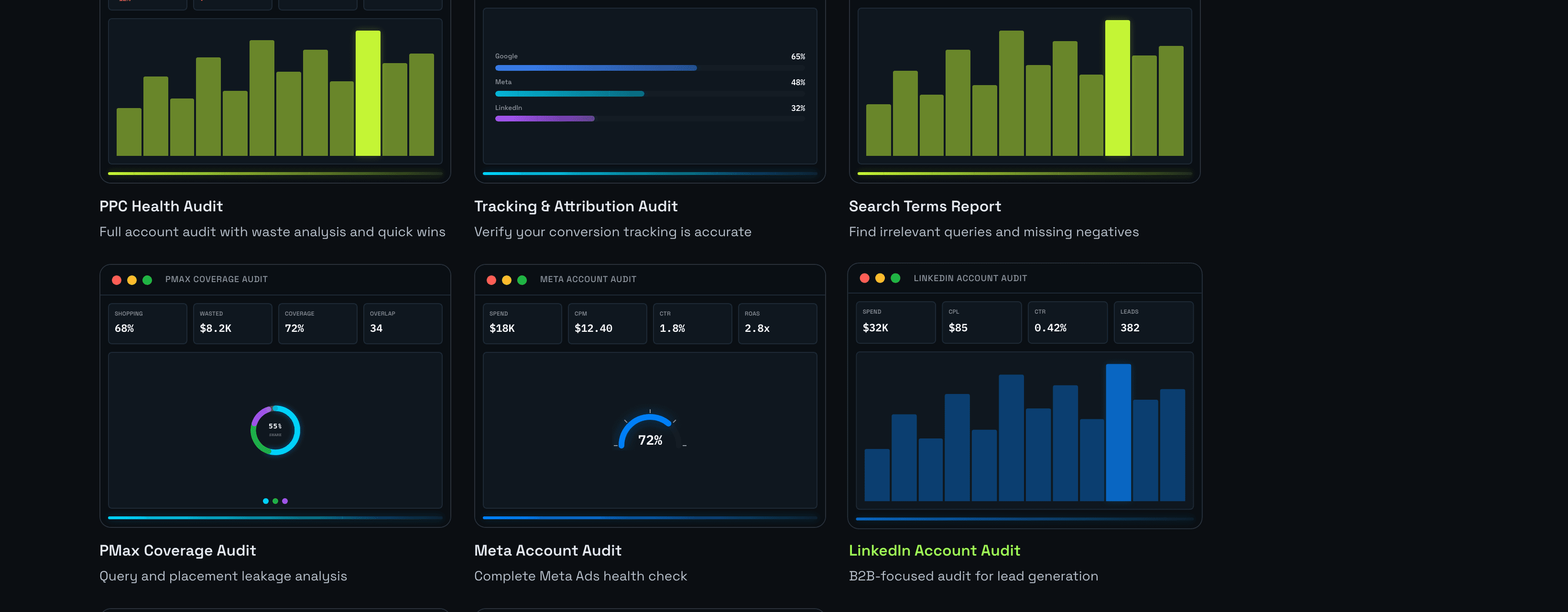
Regular audits catch problems early and surface opportunities. What used to take days, AI does in minutes.
Full Account Audit
Comprehensive Audit
"Run a full audit of my [platform] account. Check for: wasted spend (poor performing segments, irrelevant search terms), structural issues (ad group organization, audience overlap), performance problems (high CPA campaigns, declining metrics), and opportunities (campaigns ready to scale, successful elements to expand). Give me a prioritized list of fixes with estimated impact."
Focused Audits
Search Terms Audit
"Analyze my search query report for the last 30 days. Find: wasted spend on irrelevant queries, high-performing queries not yet added as keywords, and recommended negative keywords. Quantify the spend we could save."
Audience Audit
"Review my audience targeting across all campaigns. Are there overlaps causing us to bid against ourselves? Which audiences are underperforming? Where could we expand or refine?"
Creative Audit
"Analyze creative performance across campaigns. Which ads have fatigued? Which are still performing? What themes work best? What should we make more of? What should we retire?"
Tracking Audit
"Review my conversion tracking setup. Are all important actions being tracked? Are there gaps? Are conversion values accurate? Is anything broken or misconfigured?"
Team Processes
AI workflows for marketing teams
When your whole team uses AI effectively, output multiplies. Here's how to systematize it.
Handoffs and Documentation
Account Documentation
"Document the current state of our [platform] account. Include: active campaigns and their purpose, recent changes made, ongoing tests and status, key things to watch, and context someone new would need to take over."
Onboarding New Team Members
Account Overview
"I'm onboarding someone new to our [platform] account. Create an overview covering: account structure and why it's set up this way, our main goals and KPIs, what's working well right now, known issues or areas being improved, and key historical context."
Standardizing AI Use
Building Team Playbooks
Don't let everyone reinvent the wheel. Document the prompts and workflows that work best for your team.
- •Create a shared doc of proven prompts for common tasks
- •Standardize how you provide context (template for campaign info, goals, etc.)
- •Define which decisions AI can recommend vs. which require human approval
- •Set expectations for how to verify AI outputs before acting on them
Testing Systems
Learn systematically, not randomly
Random testing is expensive guessing. Systematic testing builds compounding knowledge. AI can help you design, run, and analyze tests properly.
What to Test (Priority Order)
- 1Audiences
The biggest lever. Who you reach matters more than what you say.
- 2Offers
What you're asking people to do. Demo vs trial vs download vs buy.
- 3Messaging Angles
The core concept or hook. Problem vs aspiration vs social proof.
- 4Creative Executions
Different ways to express the same message. Format, imagery, copy.
Testing Prompts
Test Design
"I want to test [variable] on [platform]. Help me design the test: how to structure it, what sample size I need for significance, how long to run it, and how to analyze results. My current [metric] is [X]."
Test Analysis
"Analyze my [A/B test details]. Is there a statistically significant winner? What can I conclude? What should I test next based on these results?"
Learning Documentation
"Document the learnings from [test/quarter/campaign]. What did we test? What won? What lost? What hypotheses were confirmed or rejected? What should we test next?"
Forecasting & Planning
See around corners
Good forecasts help you plan resources, set expectations, and catch problems before they hit. AI can build forecasts from your historical data.
Forecasting Prompts
Performance Forecast
"Based on our performance trends, forecast next month's results. Account for: historical patterns, recent trajectory, planned changes, and seasonal factors. Give me a range (conservative, expected, optimistic) with assumptions for each."
Budget Scenario Planning
"I'm considering [increasing/decreasing] budget to $[X]. Based on our historical efficiency and platform dynamics, what results should I expect? What are the risks? At what point would I expect diminishing returns?"
Goal Setting
"Help me set realistic targets for next [quarter/year]. Based on our historical performance and growth trends, what's achievable? What's a stretch goal? What would we need to change to hit an aggressive target?"
Automation Architecture
Let systems run so you can think
The goal isn't to automate everything—it's to automate the repetitive so you can focus on the strategic. AI can help you design rules that react to performance in real time.
Automation Rule Examples
Designing Your Automation
Automation Rules
"Help me design automation rules for my [platform] account. I want to: protect against runaway spend, catch performance drops early, identify scaling opportunities, and reduce manual monitoring. For each rule, specify the trigger, threshold, and action."
Automation Philosophy
Start with alerts before auto-actions. It's easy to set rules that look good in theory but cause chaos in practice. Begin by getting alerts, learn what thresholds make sense for your account, then graduate to automatic actions once you trust the rules.
Synter AI Agents
Your always-on marketing team
Synter comes with specialized AI agents that handle different aspects of your marketing workflow. Each agent is trained for a specific domain—so you get expert-level output, not generic AI responses.
How Agents Work
Unlike generic AI chat, Synter agents:
- →Connect directly to your ad platforms — Pull real data from Google, Meta, LinkedIn, Reddit, and more
- →Take actions on your behalf — Create campaigns, adjust bids, pause underperformers
- →Learn your context — Understand your goals, brand, and historical performance

Chat with your ad data
"Analyze my Google Ads spend and recommend budget reallocations to improve ROAS"
Synter agent analyzing campaign performance in real-time
Optimization Agents
Maximize ROI automatically
Budget Optimizer
Reallocates spend across platforms based on ROAS. Identifies where to scale and where to cut.
Bid Optimizer
Recommends bid adjustments based on performance patterns. Handles day-parting, device modifiers, and audience bids.
Campaign Health Monitor
Watches your campaigns 24/7. Alerts you when metrics fall outside expected ranges.
Creative Agents
Generate ads that convert
Ad Copy Generator
Creates RSA headlines, descriptions, and ad variations. Trained on high-performing ad patterns.
Creative Generator
Produces ad creatives optimized for each platform's specs—images, videos, and copy.
Generate high-converting ad copy
"Generate 5 Google Ads headlines for our AI marketing platform targeting CMOs"
Ad Copy Generator creating headlines for a B2B campaign
Intelligence Agents
Research and analysis on autopilot
Keyword Research
Finds high-intent, low-competition keywords. Uses the 6 Circles Method for comprehensive coverage.
Competitor Analysis
Monitors competitor ads via Facebook Ads Library and auction insights. Spots opportunities.
Audience Targeting
Builds custom audiences based on your ideal customer profile. Handles B2B targeting complexity.
Execution Agents
Launch and manage at scale
Cross-Platform Launcher
Deploy campaigns to multiple platforms simultaneously. One brief, all channels.
Conversion Tracking
Verifies and sets up conversion tracking. Checks GTM, pixel installation, and attribution.
Multi-Channel Reporting
Generates unified reports across all your platforms. Executive summaries to granular breakdowns.
Getting Started
All agents are available in the Campaign IDE. Just describe what you need—Synter routes your request to the right agent automatically. Or invoke a specific agent by name for more control.
Start Today
You don't need to overhaul your entire workflow at once. Pick one area—maybe your weekly reporting, or your account audits—and start using AI there. Build confidence, then expand.
The marketers who will thrive in the next era aren't the ones who know the most about AI. They're the ones who figure out how to use AI to know more about their customers, their market, and their business.
This guide will continue to evolve. The principles are durable, even as the tools improve.
Need Help?
Have questions about implementing these strategies? Want to see how Synter can help automate your workflows?
Synter Capabilities
What you can do once you're connected. Copy any prompt below into the Synter chat.
Customer UTM → CRM Attribution
When a Google ad click lands on your site, Synter captures theutm_* +gclid on the URL and writes them to the matching Person record in your connected CRM (Attio is fully wired; HubSpot/Salesforce coming next). End result: every lead in your CRM shows the ad source, campaign, and ad group it came from.
Requires: Google Ads + GTM + Attio connected. The Synter pixel installs into your GTM container with one command (no code on your site).
Set it up end-to-end
"Set up customer UTM attribution from my Google Ads to Attio. Audit my final_url_suffix, ensure UTM attributes exist on Attio people, and install the Synter pixel into my GTM container."
Audit only
"Why aren't my Google ad clicks showing up with the right utm_source in my Attio CRM?"
AI Image Generation
Generate on-brand ad creative in any platform's native size using Imagen 4, Flux, or SDXL. Synter pulls your brand colors, fonts, and logo from your website automatically and applies them to every generation.
Cost: ~$2.00 (Imagen 4) per image. Saved to your artifact store and re-usable across campaigns.
Display ad hero
"Generate a 1200x628 display ad hero for our Q1 retargeting campaign. Show a developer using our dashboard. Match our brand colors."
Native sizes for a campaign
"Generate the 4 standard Google Display sizes (1200x628, 1200x1200, 1080x1080, 300x250) for our 'Free Trial' campaign."
AI Video Generation
8-second product videos via Veo 3.1, longer scripted UGC via Creatify, fast cinematic shots via Luma. Synter handles upload to YouTube and creates a Demand Gen campaign in one shot.
Cost ranges: Veo ~$27.50 / 8s, Luma ~$3.25 / 5s, Creatify ~$22.50 / 30s, HeyGen avatar ~$22.50.
Generate + launch
"Generate an 8-second Veo video of a developer typing on a laptop with our dashboard on screen, upload it to YouTube, and create a $75/day Demand Gen campaign targeting 'growth marketing tools'."
UGC-style testimonial
"Make a 30-second Creatify UGC video where a marketer talks about saving 10 hours a week using Synter. Casual, talking-to-camera."
Landing Pages
Synter generates a complete, responsive landing page from a chat prompt and hosts it at syntermedia.ai/lp/{slug} or on a custom domain you point at us. All standard tracking pixels (Google, Meta, LinkedIn, Reddit, TikTok) auto-inject — you don't install anything.
Cost: $3.38 per page (uses Claude Sonnet for copy + structure). Custom domain mapping is free.
Build a campaign LP
"Build a landing page for our Q1 'Free Audit' campaign. Pull testimonials from our X account, include a pricing table, and add a sticky mobile CTA bar."
Map a custom domain
"Point landing.acme.com at the LP we just built and verify the DNS."
Synter Pixel (GTM auto-install)
One pixel that captures UTMs, click IDs, page views, and form submissions on your site. Auto-detects forms from HubSpot, Typeform, CF7, Webflow, Framer, and native HTML — no manual tagging. Synter pushes the pixel into your GTM container as a Custom HTML tag and publishes it for you.
Forwards lead events to your CRM (Attio today; HubSpot, Salesforce next) and conversion events to Meta CAPI, Google Offline, Reddit CAPI, TikTok Events, and LinkedIn CAPI.
Install on my site
"Install the Synter pixel on acme.com via my GTM container and publish it."
Verify it's firing
"Show me the last 24 hours of pixel events on acme.com — break down PageViews vs Leads and tell me if anything looks wrong."
Competitor-Inspired Creative
Synter scrapes your competitor's top-performing ads from the Meta Ads Library, identifies the patterns that drive engagement, and then generates new creative inspired by those patterns — but with your brand, voice, and offer. Goes beyond audit-style competitor analysis: it ships finished ads.
Cost: $2.13. Outputs an image or video plus matching ad copy ready to drop into a campaign.
Image variant
"Look at Ridge Wallet's top Meta ads, then generate an image ad inspired by their best-performing patterns but for Synter."
Video variant
"Analyze Notion's TikTok ads from the last 30 days and create a 15-second video for Synter using the same hook structure."
The Strategist
A senior-level advisor powered by GPT-5.2 reasoning. Use it when you want a verdict, not a task: "is this campaign structure right for my goal?", "should I move budget from Search to PMax?", "is my account audit-ready?" Returns a verdict, prioritized recommendations, warnings, and next steps.
Account audit
"Have the Strategist audit my Google Ads account 5859054137 and tell me the top 3 things hurting my ROAS."
Budget reallocation
"Ask the Strategist whether I should shift 30% of my Search budget into Performance Max for Q2."
Audience Sync
Upload a list of emails, company names, or domains to create matched audiences across Google (Customer Match), Meta (Custom Audiences), LinkedIn (Matched Audiences), and Reddit. Use the same list to spin up a campaign targeting only that audience.
Common workflows: enrich a Clay/Attio list and push to ad platforms, sync your customer base for lookalike modeling, build retargeting audiences from CRM segments.
Sync a CRM list
"Take my Attio list 'Q1 Pipeline' and create matched audiences on Google, Meta, and LinkedIn."
Sync + launch
"Upload these 500 emails to Google Customer Match and create a $50/day Search campaign targeting only that audience."
Email & Ad Integration
Connect your email platform (Loops) to Synter to run email engagement data back into your ad targeting — automatically. Email opens, clicks, and deliveries become real-time signals for Custom Match audiences across Meta, Google, and LinkedIn.
Three core workflows: retarget email non-openers with paid ads (same offer, new channel), suppress email converters from cold prospecting (stop paying for already-engaged contacts), and seed lookalike audiences from your best email clickers (highest-intent seed you own).
Retarget non-openers
Pull everyone who received your email but didn't open it. Push to Meta/Google as a Custom Audience and run email-matched creative. 15–30% incremental conversion lift.
Suppress converters
The moment someone clicks or converts via email, exclude them from cold prospecting audiences. Stop paying $8–12 CPM for people you already have.
Seed lookalikes
Email clickers are the strongest lookalike seed you own. Upload the last 30–90 days of clickers to Meta/LinkedIn for 2–4× better match quality vs. cold CRM lists.
Retarget non-openers
"Get everyone who received my June 20 campaign but didn't open it, then push them to Meta as a retargeting audience called 'June 20 Non-Openers'."
Suppress email converters
"Exclude everyone who clicked the pricing link in last week's campaign from our Meta and Google prospecting audiences."
Seed a lookalike
"Build a 1% lookalike on LinkedIn from everyone who clicked any email in the last 60 days."
Setup: Connect Loops in Settings → Credentials → configure the webhook (URL + secret shown in the card) → enable email.opened/clicked/delivered events. See /docs/integrations/loops for the full guide.
Spotify Ads
Audio and podcast ad campaigns on Spotify. Synter can list your ad accounts, create audio campaigns, target by genre or demographic, pull metrics, and pause/resume — same chat interface as every other platform.
Launch an audio campaign
"Create a Spotify audio campaign targeting podcast listeners interested in tech and business, $30/day, US-only."
Performance check
"Pull Spotify performance for the last 7 days and compare CPM vs my Meta and LinkedIn campaigns."
Slack Bot
Hit Synter from Slack with the /synter slash command. Same agent, same tools, same data — just from your channel.
Get prompt suggestions
"/synter prompts"
Link your account
"/synter link you@yourcompany.com"
Ask anything
"/synter how is my Google Ads pacing this month?"