Most cross-channel advertising still runs on human reaction time. A bid is too high on Google, a budget is stranded on a fading TikTok audience, a LinkedIn creative is fatiguing, and someone notices on Thursday during the weekly review. By then the money is spent. The promise of autonomous optimization in cross-channel advertising is that the noticing, deciding, and acting all happen continuously, across every platform you connect, without waiting for a human to open a dashboard. It isn't a far-off vision either: the pieces (agentic AI, unified platform access, and closed-loop measurement) are shipping now, and the operators who wire them together over the next 12 to 24 months can compound an advantage that manual teams will struggle to match. Here's what that shift actually looks like, where it bites first, and what stays firmly in human hands.
What "autonomous optimization" means for cross-channel advertising
Autonomous optimization is advertising that adjusts itself. An AI agent watches live performance across your channels, decides what to change (bids, budgets, audiences, creative), and executes those changes directly in the ad accounts, continuously and without a human approving each step. You set the goal and the guardrails. Many teams phase that authority in with staged changes, approval thresholds, and exception queues rather than granting it all at once, a nuance the maturity curve below spells out. The system handles the thousands of micro-decisions in between.
That last clause is the part that separates it from what most teams call automation today. Smart Bidding optimizes a bid inside one platform. Autonomous optimization decides that the bid should drop on Google, the saved budget should move to Reddit, and a new creative variant should ship to the audience that's converting, all as one coordinated move. The unit of control shifts from the individual setting to the outcome you actually care about.
From manual to self-driving: the marketing-automation maturity curve
It helps to think about ad operations the way the industry thinks about self-driving cars: as a spectrum, not a switch. Each stage hands more of the loop to the machine, and most teams sit somewhere in the middle, not at either end.
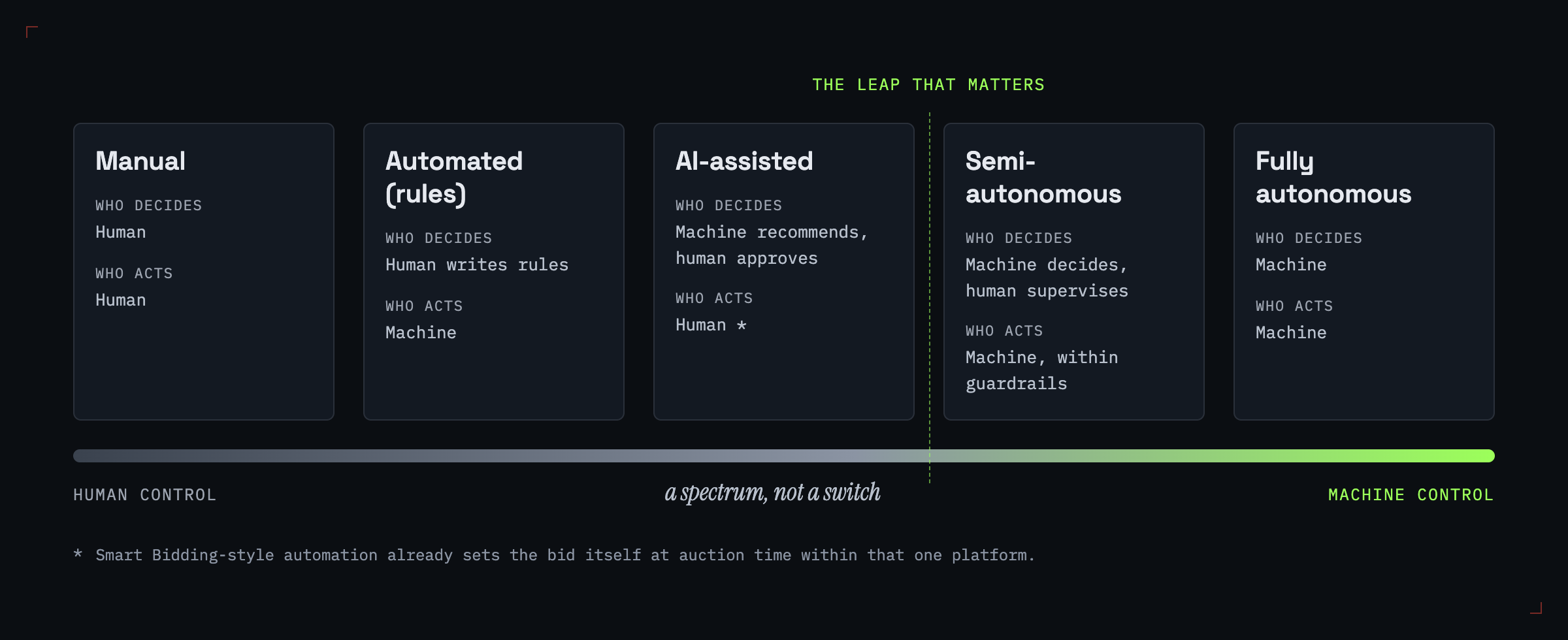
| Stage | Who decides | Who acts | What it looks like in cross-channel ads |
|---|---|---|---|
| Manual | Human | Human | Analyst pulls reports from each platform, sets bids and budgets by hand, edits creative in separate tools. |
| Automated (rules) | Human writes rules | Machine | Rule-based scripts pause a keyword over a CPA threshold or shift budget on a fixed schedule. |
| AI-assisted | Machine recommends, human approves | Human | Native tools split here: recommendation engines suggest a change and a marketer clicks apply, while Smart Bidding-style automation already sets the bid itself at auction time within that one platform. Either way, a person still manages budgets and moves across platforms by hand. |
| Semi-autonomous | Machine decides, human supervises | Machine, within guardrails | Agents reallocate budget across platforms and adjust bids inside set limits; humans review exceptions. |
| Fully autonomous | Machine | Machine | Agents run the full perceive-decide-act loop across every connected channel against a goal; humans set strategy and audit. |
The leap that matters for cross-channel work is from AI-assisted to semi-autonomous. AI-assisted tools have existed for years, and they're useful, but they still bottleneck on a person clicking "apply" in each platform's UI. Rule-based automation removes the click but not the rigidity: a rule that says "pause at $50 CPA" can't tell the difference between a temporary spike and a real loss. Semi-autonomous agents close that gap because they decide and act inside boundaries you define, then surface only the exceptions worth your attention.
Rule-based automation is the right tool for plenty of teams, especially when spend is small, or the account is simple. The maturity curve isn't a ranking of good to bad so much as a map of how much judgment you're comfortable delegating, and that answer is different for a solo founder than for an agency running 200 accounts. For regulated industries or high-spend enterprise accounts, semi-autonomous with approval gates can be the durable operating model in its own right, not just a waypoint on the way to fully autonomous.
Why cross-channel is where autonomous optimization matters most
Single-platform automation has been around long enough to feel ordinary. The hard, unsolved problem has always been the space between platforms, and that's exactly where autonomous optimization earns its keep.
Budget allocation across channels is a decision no single platform can make for you. Google's algorithm optimizes within Google. Meta optimizes within Meta. Neither one knows or cares that your dollar would perform better on the other. A human bridges that gap by exporting numbers, comparing them in a spreadsheet, and moving budget manually, which means the reallocation happens on a weekly cadence at best. An agent that connects across 27 ad platforms can see the whole board and move budget toward whatever is converting today, not last Thursday. That is the decision rule-based tools and single-platform algorithms generally can't make on their own: reallocating across accounts based on which one is actually returning.
The fragmentation problem is getting worse, not better. New surfaces keep appearing (retail media, connected TV, even ad inventory inside AI assistants), and each one adds another silo of customer data and another set of controls to learn. McKinsey describes the result as a "patchwork of disconnected pilots and systems," noting that "nearly 90 percent of CMOs are experimenting with AI use cases\... but less than 10 percent have captured value across end-to-end workflows". The lesson there isn't so much that AI doesn't work, but that point tools bolted onto fragmented channels rarely move the needle; unifying the channels under one decision-making layer is what tends to.
How autonomous cross-channel optimization works under the hood
Underneath the marketing language, an autonomous ad system runs a familiar loop: perceive the current state, reason about what to change, act on the accounts, and measure the result so the next decision is better informed. What makes the cross-channel version hard is that every step has to span platforms with different APIs, metrics, and conventions. Three capabilities make it work.
Continuous bid and budget reallocation across platforms
This is the core lever. Instead of optimizing each platform in isolation, the agent treats your entire media mix as one portfolio and moves money toward the channel with the strongest marginal return in real time, provided that return is grounded in incrementality testing or careful modeling rather than read straight off an attribution dashboard, which can flatter channels that only look responsible for a sale. McKinsey, describing an advertising platform building exactly this, says its agents are "continuously evaluating performance, adjusting bids and budgets, pairing creative with audiences" and operating in real time, "managing thousands of microadjustments that previously required constant manual oversight." Reallocation is the decision a spreadsheet does monthly and an agent does hourly, though that cadence only helps when it runs inside cooldown windows, minimum data thresholds, and caps on how much can move at once, so the agent doesn't chase noise or reset a channel's learning phase.
Real-time creative and landing-page optimization
Bids and budgets are only half the equation. The other half is what the ad says and where it lands. Autonomous systems extend the loop into creative: generating variants, rotating them, retiring the ones that fatigue, and matching message to audience. The destination matters too, because a perfectly optimized click into a generic landing page leaks conversions. Pulling creative generation, ad copy, and landing-page assembly into the same loop as bidding is what makes the optimization end-to-end rather than just budget-level.
Measurement that closes the loop (multi-touch attribution and incrementality)
None of this works without trustworthy feedback. If the agent optimizes toward last-click conversions, it can starve the upper-funnel channels that actually drive demand. Closing the loop requires multi-touch attribution that credits each touchpoint and, ideally, incrementality testing that distinguishes ads that caused a conversion from ads that merely got credit for one. The two solve different problems: multi-touch attribution assigns credit across the touchpoints it can see, while incrementality estimates the causal lift those touchpoints actually produced. The cleaner the conversion signal flowing back, the better every downstream decision gets. Garbage in, garbage optimized.
The new role of the marketer: goals, guardrails, and oversight
If agents handle execution, what's left for the people? More than the anxious framing suggests, and arguably the more interesting half. McKinsey describes the emerging model as a hybrid workforce in which "people design and oversee networks of AI agents that handle most of the execution." The marketer stops being the person who adjusts bids and becomes the person who decides what the system is optimizing for, and where it isn't allowed to go.
Three jobs move to the center:
- Setting goals. Target ROAS, CPA ceilings, growth-versus-efficiency tradeoffs, which audiences are off-limits. The agent optimizes toward whatever you point it at, so pointing it correctly is the whole game.
- Defining guardrails. Maximum daily spend, brand-safety rules, channels that require sign-off, the line between a change an agent makes alone and one it proposes for review. In practice, this is where a control surface like a Campaign IDE earns its place, giving you a spot to set instructions, review work, and approve the changes that should never be fully automatic.
- Auditing and judgment. Catching the strategy mistakes a metric-chasing agent can't see, like optimizing a campaign into a profitable corner that quietly shrinks the brand.
Left unmonitored, plenty of ordinary failures can masquerade as a bad autonomous decision: broken conversion tracking, delayed or offline conversions, platform API outages, learning-phase resets, false-positive creative-fatigue calls, and even prompt or tool-injection attempts buried in campaign data can all steer an agent wrong if nobody is watching.
There's a credibility check buried in this section, and it's worth stating plainly: autonomy without oversight is how budgets get wrecked. Gartner predicts that over 40% of agentic AI projects will be canceled by the end of 2027 due to escalating costs, unclear business value, or inadequate risk controls, a broad forecast about agentic AI overall, not one specific to ad operations. The teams that get this right don't remove humans from the loop; they move humans up the stack, from clicking apply to setting the rules the agents run on.
What an autonomous ad operator looks like in practice (featuring Synter)
The thesis is easier to picture with a concrete example, so we'll use our own. We built Synter as an AI agent operator for ads, and its architecture maps onto the loop described above, which makes it a useful illustration of where the category is heading. For how we stack up against the rest of the field, see our roundup of cross-channel advertising platforms.
The foundation is unified access. We connect across 27 ad platforms through a single layer built on the Model Context Protocol, an open-source standard for connecting AI applications to external systems, plus a REST API, so an agent can read, write, and execute in Google, Meta, LinkedIn, TikTok, and the rest from one place instead of platform by platform. That unified access is the precondition for cross-channel decisions; you can't reallocate budget across silos you can't reach. MCP standardizes the interface, not the underlying constraints: execution still runs through each platform's REST APIs, OAuth scopes, permissions, rate limits, and whichever write operations and policies that platform allows.
On top of that, the autonomous optimization layer does the work the maturity curve calls semi-autonomous: agents adjust bids on real-time performance data, pause underperformers when CPA exceeds your thresholds, reallocate budget across platforms by ROAS, and scale winning audiences. We split the product explicitly into two modes: "you direct," where you instruct and approve changes, or "they execute 24/7" against goals and guardrails you set. Creative isn't left out either. Our agents generate images, video, and full landing pages, and feed multi-touch attribution back into bidding so the loop actually closes.
Worth noting for any team evaluating this category: maturity and performance claims deserve scrutiny, and that applies to us too. Review each vendor's current security documentation and test performance against your own account baseline, conversion definitions, and attribution model rather than accepting an aggregate headline.
The road ahead: autonomous optimization over the next 24 months
The direction of travel is clear even if the timeline is fuzzy. A separate Gartner prediction speaks to the upside: agentic AI is expected to make at least 15% of day-to-day work decisions autonomously by 2028, and ad operations is one of the most measurable, fastest-feedback domains there is, which makes it a natural early adopter. McKinsey's estimate of the ceiling runs higher; the firm suggests agentic AI could "come to power as much as two-thirds of current marketing activities" and that teams reinventing their workflows around it can expect 10 to 30 percent revenue growth from better personalization.
A few shifts look likely over the next 12 to 24 months. First-party data and privacy-first measurement become the fuel, since an agent is only as good as the conversion signal it learns from. Open standards like MCP make agents portable across the AI apps marketers already use, so the control layer stops being locked to one vendor's dashboard. And the competitive gap widens quietly: a team running continuous cross-channel reallocation learns from far more decisions per week than a team optimizing by hand, and that compounding is hard to catch up to. The risk, per Gartner, is real, and it falls on the teams that let costs escalate, value stay unclear, or risk controls lapse. The opportunity falls on the ones that build those rails first.
Conclusion: where to start
Cross-channel advertising is moving from human-tuned campaigns to AI agents that optimize bids, budgets, creative, and channel mix continuously, with people setting the strategy and guardrails instead of clicking apply. The shift is already underway; the analyst data backs the direction, and the early movers are quietly compounding an advantage. You don't have to hand over the whole account on day one. Start by picking one cross-channel decision you make too slowly today (budget reallocation is the usual culprit), give an agent the access and guardrails to handle it, and watch the loop tighten.
If you want to see the thesis running rather than just read about it, review the current plans and connect the accounts you want to evaluate. The future of cross-channel advertising probably won't announce itself with a press release; it'll show up as the competitor whose budget is always already in the right place.