Rule-based PPC automation works, and it has for years. A bid rule that pauses a keyword when its CPA crosses a threshold, a script that pushes budget to your best campaign every Monday, a bulk edit that rewrites 4,000 ad groups in one pass: these save real hours, and they do exactly what you told them to do, every time. For a tightly scoped Google Ads account, that predictability is the whole point, and there is no reason to trade it away.
But most PPC automation tools now sit somewhere on a spectrum, and the far end has changed. Autonomous AI agents don't just execute your instructions; they pursue your goals across channels and adjust on their own, which is a different relationship with your account than a rule has. That said, an agent is only as good as what it measures: if conversion tracking is broken or attribution is biased, agents can optimize quickly toward the wrong outcome. This guide compares the two models on how they make decisions, how fast they react, and how much control you keep, so you can decide how much of the campaign work to hand over and where to draw the line.
What Is PPC Automation? (Definition & Why It Matters)
PPC automation is the use of software to run pay-per-click tasks, like setting bids, pacing budgets, generating ad copy, and pausing weak campaigns, without a person doing each step by hand. It spans simple if/then rules inside an ad platform all the way to AI systems that make and execute decisions on their own.
It matters because manual campaign management stops scaling well past a certain point. A single advertiser running Search, Performance Max, Meta, and LinkedIn juggles dozens of bid and budget decisions a day across interfaces that don't talk to each other, and most of those decisions are mechanical. Automation absorbs the repetitive part. The open question, and the reason this comparison exists, is how much judgment you delegate along with the busywork.
The Two Models: Rule-Based Automation vs Autonomous AI Agents
A useful way to think about PPC automation is a single distinction: rule-based automation executes your instructions; autonomous AI agents pursue your goals.
Rule-based automation runs on conditions you define in advance. Google's automated rules are the canonical example. They "make automatic account changes based on chosen settings and conditions", so you can "boost your keyword bid any time your ad falls off of the first page of Search results". You write the logic; the tool fires when the condition is true. Scripts and bulk editors work the same way, just with more reach. The behavior is deterministic, which is exactly why teams trust it: a rule almost never surprises you, and that is both its strength and its ceiling.
Autonomous agents start from a goal and a set of guardrails, then can decide and execute some of the steps themselves, often through approval gates, hard thresholds, or recommend-first modes rather than full independence. Instead of "if CPA \> $40, pause," you tell an agent "hit a $30 CPA at this budget" and it works out which levers to pull. This is the model behind newer AI-driven, autonomous ad automation platforms. Synter, for one, runs agents that adjust bids on real-time performance data, pause underperformers when CPA exceeds thresholds, reallocate budget across platforms based on ROAS, and scale winning audiences automatically. The difference from a rule is subtle but real: the agent chooses the action, not just the trigger.
There's a middle layer worth naming, because it muddies the binary. Platform-native machine learning, like Google's Smart Bidding, already optimizes "for conversions or conversion value in each and every auction" using "machine learning algorithms" trained "on data at a vast scale". That's more than a rule but less than a cross-channel agent. So most teams are already further up the spectrum than they think, even if they never set out to be.
Types of PPC Automation (Where Each Tool Sits on the Spectrum)
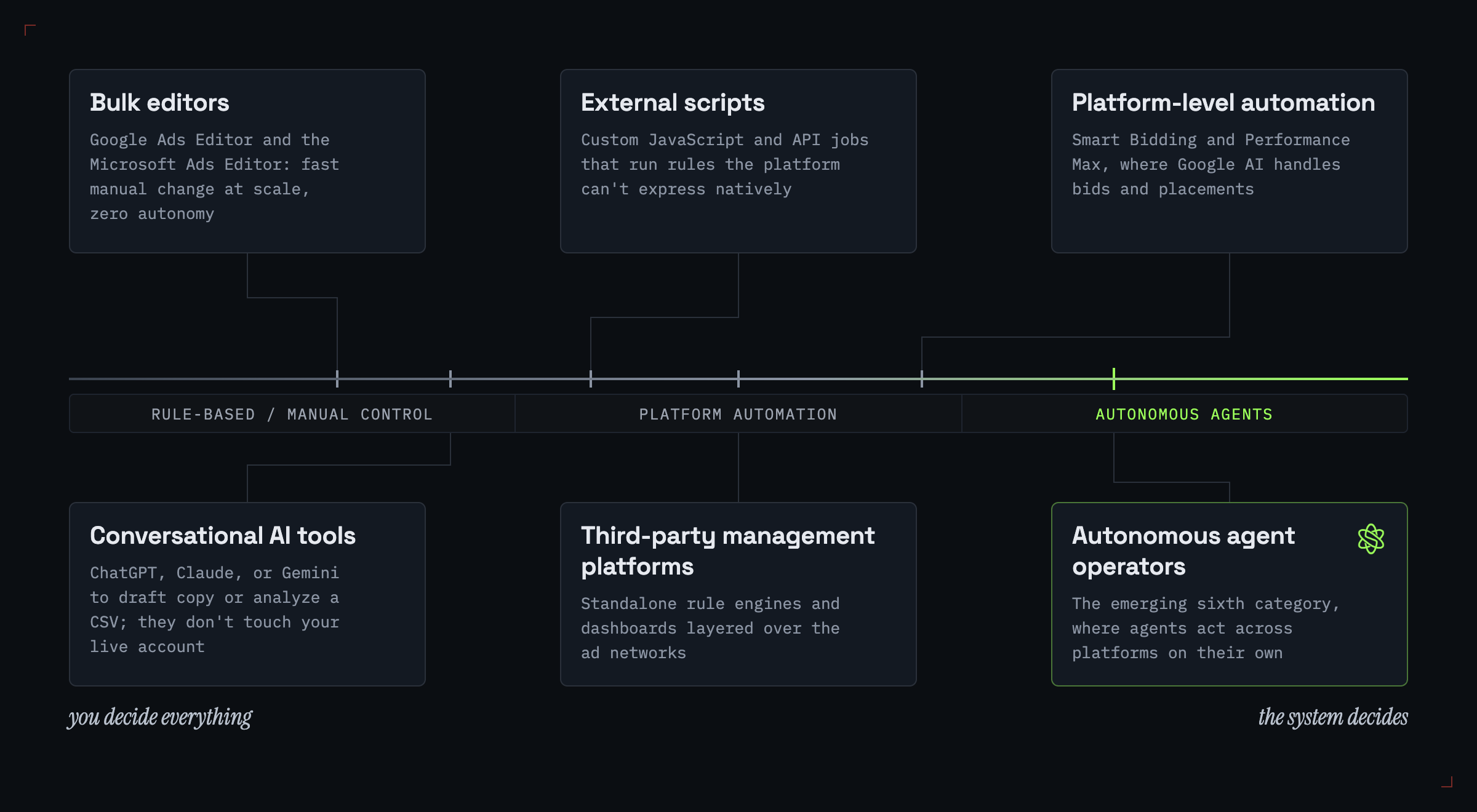
Most PPC automation tools fall into one of six categories, arranged here from "you decide everything" to "the system decides."
- Platform-level automation. Smart Bidding and Performance Max, where Google AI handles bids and placements. Performance Max is "a goal-based campaign type that allows performance advertisers to access all of their Google Ads inventory from a single campaign". It can do a lot inside one ad network, but it's limited to Google's ecosystem and partner inventory beyond it.
- Bulk editors. Google Ads Editor and the Microsoft Ads Editor: fast manual change at scale, zero autonomy. You still make every decision; the tool just applies it everywhere at once.
- External scripts. Custom JavaScript and API jobs that run rules the platform can't express natively. Flexible, but someone has to write and maintain them, and that someone is usually already busy. Our guide to Google Ads automation software and scripts covers this layer in more depth.
- Conversational AI tools. Using ChatGPT, Claude, or Gemini to draft copy or analyze a CSV. Useful for thinking out loud; they don't touch your live account.
- Third-party management platforms. Standalone rule engines and dashboards layered over the ad networks, often with better reporting than the platforms ship natively.
- Autonomous agent operators. The emerging sixth category, where agents act across platforms on their own. If you want a vendor-by-vendor view of the first five, our roundup of the best PPC automation tools breaks them down.
Rules-Based vs Autonomous Agents: A Side-by-Side Comparison
Here is how the two ends of the spectrum compare on the dimensions that actually decide which one you reach for.
| Dimension | Rule-Based Automation | Autonomous AI Agents |
|---|---|---|
| How decisions are made | Conditions you define in advance (if/then) | Goals plus guardrails; the agent chooses the actions |
| Reaction speed | Runs on a schedule or when a condition fires | Continuous or frequent, where platform data and APIs allow |
| Cross-channel reach | Mostly per-platform; cross-platform reach needs custom middleware to build and maintain | Cross-channel; reallocates budget by ROAS across platforms |
| Visibility/transparency | High; you can read every rule | Needs an audit trail and reporting to stay legible |
| Setup & maintenance | Manual to build, manual to keep current | More upfront trust; still needs monitoring, guardrail updates, and periodic review |
| Scalability | Breaks down as rules multiply and conflict | Can scale better with account complexity if guardrails and measurement are strong |
| Failure mode | Misses anything no rule anticipated | Can optimize confidently toward the wrong goal |
| Best-fit team | Simple accounts wanting maximum determinism | Growing, multi-platform teams that can set oversight |
The pattern in the table is the trade you're really making: rules give you certainty and ask for maintenance, while agents give you adaptability and ask for trust. Neither column is the "right" one in the abstract. For most teams, the practical question lands on automated bid and budget optimization specifically, namely how much of it to hand off and with how much human oversight in the loop.
Strengths, Limits & Risks of Each Approach
Rule-based automation is predictable and transparent, and that's its real strength. Every action traces back to a condition you wrote, so when something fires, you know exactly why. The limit is brittleness. A rule only handles the cases you anticipated, and a new failure pattern, a competitor's sudden price cut or a CPC spike on one device, sails right past it. Worse, rule sets rot over time. Add enough of them, and you get conflicts, where one rule raises a bid the next one cuts, and nobody on the team remembers which was supposed to win.
Autonomous agents are adaptive and they scale, which is exactly why they need guardrails. An agent that reallocates budget across platforms in real time can capture opportunities a static rule would never see. But automation can also confidently optimize toward the wrong outcome when the goal or the conversion data feeding it is poor. Point an agent at a mismeasured conversion, and it can pursue the wrong target faster and more thoroughly than a human would, because that is what it was built to do. So the risk profiles end up as rough mirror images, with rules tending to fail by omission and agents by overcommitment.
This is why oversight features matter more for the agent model than for the rule model. An audit trail, role-based access, and clear thresholds can feel like bureaucracy, but they're what keeps an autonomous system legible enough to trust with a real budget. In practice, that means setting concrete limits before agents touch a live budget:
- a max daily spend change
- a max bid or budget change per period
- cooldown windows between adjustments
- minimum conversion thresholds before an agent acts
- approval gates for structural changes
- alerts for tracking outages
How to Choose the Right PPC Automation Approach
Match the approach to your account, not to the hype. A few decision points:
- Solo and small-business advertisers running one or two simple accounts often get more from rule-based automation. Determinism is worth more than adaptability when there isn't much to adapt to.
- In-house performance teams managing several campaign types usually want platform automation plus light agent help, keeping a human in the loop on strategy and creative direction.
- Agencies juggling many clients and channels feel the pain of per-platform rules most acutely, which is where cross-channel autonomy starts to earn its keep.
- Enterprise teams need both at once: autonomy for scale, and strict guardrails, audit trails, and access controls for governance.
The criteria that matter are control, transparency, reliability, scalability, and integration. Weight them by account complexity and the oversight your team can actually provide. If you can't staff the oversight an agent needs, a simpler tool is the responsible choice, and there's no shame in staying where the determinism is.
Where Synter Fits: Autonomous Agents With Human Control
Synter sits at the autonomous-agent end of the spectrum, and we built it to keep the control that rule-based users value. It's an AI agent for Google Ads and the rest of our 27 supported ad platforms, and it gives you two ways to run. With "You direct," you use the Campaign IDE to instruct agents, review their work, and approve changes before anything ships. With "They execute 24/7," you set goals and guardrails, and the agents adjust bids, pause underperformers, scale winners, and report back around the clock. That toggle is aimed squarely at the rules-versus-autonomy tension: keep your hand on the wheel, or set the destination and let the agents drive.
It addresses the cross-channel gap structurally rather than with more rules. We built Synter on a unified MCP and REST interface across 27 ad platforms, a connect-once, manage-everywhere model. MCP itself is "an open-source standard for connecting AI applications to external systems", so the same agents reach Google, Meta, LinkedIn, and the rest through one interface over connected platform integrations, instead of a separate rule set per network, with each connection still governed by that platform's own API, OAuth scopes, and rate limits. The Campaign IDE is a chat-first builder with 40+ Agent Skills and real-time, Google-Docs-style collaboration, so a team can review an agent's plan together before it goes live.
On the "black box" worry, we lean on oversight rather than asking for blind faith. There are guardrails, a full audit trail, and RBAC, with an optional dedicated human media buyer working alongside the agents. Coverage also runs past bids and budgets into AI creative, landing pages generated from a single prompt, and multi-touch attribution. Rule-based tools remain the better call for simple accounts that prize maximum determinism; autonomous systems should be evaluated against a documented account baseline.
Conclusion & Next Steps
The useful question isn't really rules versus agents as rival products, but how far up the automation spectrum your account is ready to move. Rule-based PPC automation tools execute your instructions predictably, while autonomous agents pursue your goals across channels and adapt on their own. Most teams are sliding toward the agent end as their accounts get more complex, and the deciding factors stay constant: control, transparency, and the oversight you can realistically sustain.
If you want to see how autonomous agents run with guardrails in place, review the current plans and connect a single platform to watch the agents work, or book a demo if you'd rather walk through it with the team first. And if you'd rather start with a tool-by-tool list, the PPC automation tools roundup linked above covers the alternatives in detail.
FAQ
What is PPC automation? PPC automation is software that handles pay-per-click tasks, like bidding, budget pacing, ad copy, and pausing weak campaigns, without a person doing each step manually. It ranges from simple if/then rules inside an ad platform to autonomous AI agents that make and execute decisions on their own.
Are rule-based PPC tools still worth it? Yes, for the right account. Rule-based automation is predictable and fully transparent, which makes it a strong fit for simple campaigns where you want deterministic behavior and easy auditing. Its weakness is brittleness: rules only handle the cases you anticipated, and large rule sets get hard to maintain.
What is an autonomous AI agent for PPC? It's software that takes a goal and guardrails rather than fixed rules, then can decide and execute some of the steps itself, often across multiple ad platforms and often within approval gates or hard thresholds rather than full independence. Agents can reallocate budget by ROAS, pause underperformers on CPA thresholds, and scale winning audiences without a person triggering each action.
Which PPC automation tools work best for agencies? Agencies running many clients and channels tend to benefit most from cross-channel, autonomous tools, because per-platform rules multiply quickly and become unmanageable at agency scale. The key requirements are unified multi-platform control, guardrails, role-based access, and reporting that holds up across accounts.