
You can tell exactly how many clicks a campaign drove last month. Can you tell how much revenue it booked? For most teams, the answer is "not really," and that gap is where budget quietly leaks. Marketing revenue attribution closes it by tracing every dollar of closed-won revenue back to the ad, campaign, and channel that started the journey. This guide walks through what revenue attribution is, the models you'll choose between, and the step most teams skip: feeding that revenue signal back into the platforms deciding where your spend goes.
What Is Marketing Revenue Attribution?
Marketing revenue attribution is the practice of assigning credit for actual revenue, not just clicks or form fills, to the marketing touchpoints that influenced a purchase. It connects ad spend on one end to closed deals on the other, so you can see which channels generate pipeline that turns into money. Where conversion tracking counts events, revenue attribution puts a dollar figure on each one, provided the revenue data behind it is complete and properly matched.
Google frames attribution as "the act of assigning credit for important user actions to different ads, clicks, and factors along the user's path to completing the action." Revenue attribution narrows that idea to the action your CFO cares about: a paid invoice or a closed deal. The customer journey rarely runs in a straight line, so the question isn't whether a channel touched the deal, but how much it was worth.
Revenue Attribution vs. Marketing Attribution
Marketing attribution is the umbrella term for crediting touchpoints. It can stop at a conversion event, a lead, or a sign-up. Revenue attribution is the dollar-tied subset of that work: it only counts a touchpoint as valuable if the journey it belongs to produced revenue. A campaign can win on lead volume and still lose on revenue, and revenue attribution is what surfaces that mismatch before you scale the wrong thing.
Revenue Attribution vs. Conversion Tracking
Conversion tracking tells you what happened: a download, a demo request, a checkout. Revenue attribution tells you what it was worth and what influenced it. Conversion tracking is the raw signal; attribution is the interpretation that splits credit across the journey. A team can have flawless conversion tracking and still misallocate budget, because counting conversions says nothing about which ones became paying customers.
Why Tying Ad Spend to Revenue Matters Now
Leads and clicks are cheap to report and easy to game. Revenue isn't. When a board asks marketing to defend its budget, "we drove 4,000 form fills" lands very differently than "paid social generated $1.2M in closed-won revenue at a 4x ROAS." Tying spend to revenue is how marketing stops being a cost center on the slide deck and starts being a growth lever with a number attached.
The pressure is sharper now for two reasons. First, sales and marketing alignment has become a board-level metric, and a shared revenue view goes a long way toward ending the "marketing's leads are garbage/sales can't close" standoff. Second, rising customer acquisition cost means every misattributed dollar compounds. If last-touch data tells you brand search is your best channel, you'll pour money into capturing demand you already created while starving the top-funnel channels that created it. That's less a reporting problem than a budget-allocation problem, one that quietly inflates CAC and drags down ROAS quarter after quarter. Revenue attribution reframes the question from "which channel got the most conversions" to "which channel produced the most revenue per dollar spent," and the gap between those two answers is usually where the wasted spend lives.
Revenue Attribution Models Explained
An attribution model is the rule that decides how credit gets split across a journey with multiple touchpoints. Google describes it as "a rule, a set of rules, or a data-driven algorithm that determines how credit is assigned to touchpoints along a user's path." The model you pick changes which channels look like heroes, so it pays to understand the trade-offs before you trust the dashboard.
Models fall into two camps. Single-touch models (first-touch and last-touch) hand 100% of the credit to one interaction. Multi-touch models (linear, time-decay, position-based, and data-driven) spread credit across the journey. Single-touch is simpler and good for a specific question; multi-touch is closer to how B2B buying actually works, where a typical buyer touches several channels across a long sales cycle before signing.
| Model | How credit is split | Best for |
|---|---|---|
| First-touch | 100% to the first interaction | Measuring which channels create demand and awareness |
| Last-touch | 100% to the final interaction before conversion | Measuring which channels close, short sales cycles |
| Linear | Equal credit to every touchpoint | A position-neutral baseline view of the journey |
| Time-decay | More credit to recent touchpoints | Short cycles where recency drives the decision |
| Position-based (U-shaped) | 40% first, 40% last, 20% split across the middle | B2B lead gen that values both discovery and the close |
| W-shaped | Credit weighted to first touch, lead creation, and opportunity creation | Longer B2B funnels with defined pipeline stages |
| Data-driven | Algorithm assigns credit from your own conversion data | Accounts with enough volume to train a model |
Position-based, or U-shaped, attribution is related to the way people think about 50/50 first/last weighting: it loads 40% onto the first touch and 40% onto the last, then splits the remaining 20% across everything in between. A true 50/50 model would split credit only between those two endpoints, so treat "50/50" as shorthand rather than a precise description. Data-driven is the most sophisticated of the set. Google's version "uses your account's data to calculate the actual contribution of each click interaction" rather than applying a fixed rule. Read "actual contribution" as a statistical estimate built from observed paths, not causal proof, and it needs enough conversion volume to be reliable. Worth knowing: GA4 retired its first-click, linear, time-decay, and position-based models in November 2023 and now offers only three (data-driven plus two last-click variants), so if you want those classic models you'll need a dedicated tool. If you're evaluating that route, we've compared the leading multi-touch attribution software for B2B teams separately.
There's no single "correct" model. Run two or three side by side and watch how the credit shifts: if a channel looks great under last-touch but vanishes under linear, it's closing demand someone else created, not generating it. That comparison shows correlation, not causation. Attribution assigns credit to observed touchpoints; it doesn't prove a touchpoint caused incremental revenue. Before shifting serious budget on the strength of one model, validate with a holdout test, a geo experiment, or another incrementality design where you can run one.
The Missing Link: Closed-Loop Attribution
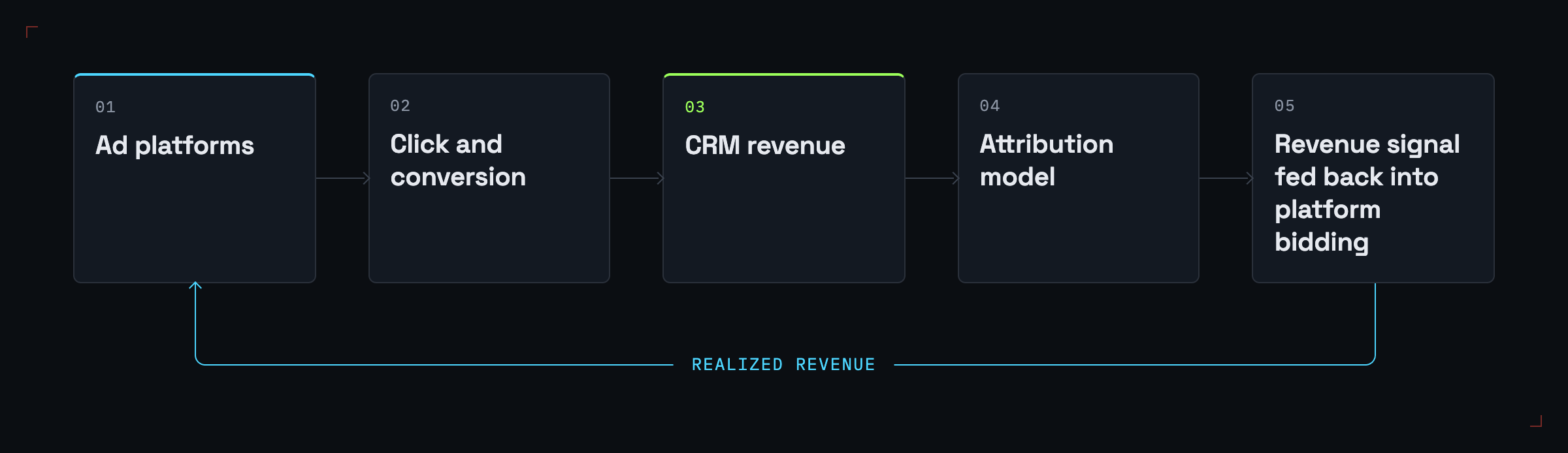
Every model above quietly assumes you already know which journeys ended in revenue. Most setups don't: they track clicks and on-site conversions, then lose the thread the moment a lead enters the CRM and the real money gets made weeks later in a sales conversation. Closed-loop attribution is the fix. It connects the front end (ad clicks and conversions) to the back end (CRM deals and realized revenue), then sends that revenue truth back to the ad platforms.
The "loop" closes when the revenue outcome returns to the system that spent the money. That last step is what separates a report you read from a system that changes what you spend.
Why Most Attribution Misses Cost and Revenue
Two blind spots break most attribution before it starts. The first is revenue: web analytics sees a conversion event but not the $45,000 deal it became three weeks later in your CRM, so credit gets assigned without knowing which journeys paid off. The second is cost: a dashboard can show conversions by channel without pulling in what each channel actually cost, which makes return-on-ad-spend impossible to calculate honestly. Clicks without dollars, and conversions without cost, add up to budget decisions made on half the picture.
There's also a durability problem. Browser-side tracking leans on cookies and pixels that are increasingly blocked or expired, which is why platform-native server-side tracking has become the more reliable path. Meta's own Conversions API documentation describes it as a connection "between an advertiser's marketing data (such as website events, app events, business messaging events and offline conversions) from an advertiser's server, website platform, mobile app, or CRM to Meta systems that optimize ad targeting, decrease cost per result and measure outcomes." Server-side tracking improves resilience against cookie loss, but it doesn't bypass consent requirements, App Tracking Transparency, platform privacy rules, or the practical limits of identity matching and deduplication. First-party data from your server or CRM survives where third-party cookies don't, but only when it's collected lawfully, matched accurately, deduplicated, and accepted by the platform on the other end.
Feeding Revenue Data Back Into Platform Bidding
This is the step that turns attribution from a scorecard into a control system. Modern ad platforms optimize against whatever conversion signal you feed them. Feed them "form submitted," and they'll chase form fills. Feed them "closed-won deal worth $45K" and they'll chase revenue, provided the matched values are accurate, volume is sufficient, conversion lag stays inside your attribution window, and the campaign has cleared its learning period; feed it thin or delayed data, and it optimizes toward noise instead. The mechanism is documented and real: Google Ads supports uploading offline conversions back to the platform through supported upload and API paths, now consolidated under the Data Manager API, and Meta's Conversions API does the same for server-side and CRM events.
We built Synter around this loop. Our closed-loop revenue attribution stitches ad clicks to website sessions to CRM deals automatically, with native sync to HubSpot and Salesforce, so revenue (not just conversions) gets attributed to the originating campaign. That stitching still depends on the basics being in place: consistent UTMs and click IDs, clean contact and account matching in the CRM, deduplication, disciplined sales-stage tracking, and consent. No platform, ours included, can connect a journey it never captured. Where we differ from measurement-only tools is the final step: that first-party revenue signal feeds back into autonomous bid and budget optimization across the platforms. Attribution that just reports leaves the reallocation to you next quarter; a closed loop can inform far more frequent reallocation instead of waiting for the next planning cycle.
| Capability | CRM-only / report-style attribution | Closed-loop attribution |
|---|---|---|
| Connects clicks to deals | Yes | Yes |
| Pulls in ad cost per channel | Often manual | Built in |
| Tracking durability | Cookie/pixel-dependent | Should include server-side/first-party where possible |
| What happens to the insight | You read a dashboard | Revenue signal feeds platform bidding |
| Effect on spend | Changes next quarter, if you act | Can inform more frequent reallocation |
How to Set Up Marketing Revenue Attribution (Step by Step)
You don't need to boil the ocean. A working revenue-attribution setup comes together in six steps, and each one is achievable with tools most teams already own.
- Set revenue goals and KPIs. Decide what "revenue" means before you measure it: closed-won deals, realized invoices, expansion, or all three. Pin down the KPIs you'll judge channels by, such as revenue per lead, pipeline sourced, and ROAS, so the model has a target. Define your attribution window and revenue-recognition rules at the same time, especially for long B2B sales cycles and subscription revenue, where booked, realized, and expansion revenue can mean different things.
- Track visitors and leads at the individual level. Aggregate channel reports can't tie a specific deal to a specific journey. Capture and persist identifiers (UTMs, click IDs, a lead ID) so a single buyer's path stays intact from first ad click to closed deal.
- Centralize CRM, ad, and conversion data. The revenue truth lives in your CRM; the cost truth lives in the ad platforms; the behavior lives in your analytics. Attribution only works once those three sit in one place and share keys, so deal-to-campaign matching can actually happen.
- Pick an attribution model (and stress-test it). Choose the model that matches your sales cycle, then run a second one alongside it. If your conclusions flip depending on the model, that's a signal to investigate, not to trust one number.
- Feed revenue back to bidding. Send the revenue outcome to the platforms as an offline or server-side conversion so their algorithms optimize toward dollars, not form fills. This is the step that closes the loop, and the one we built Synter to automate: the upload and the reallocation, rather than a quarterly manual export.
- Audit regularly. Attribution decays as tracking breaks, UTMs get sloppy, and sales stages drift. Schedule a recurring check on data completeness and model output, because a stale attribution setup can be worse than none: it looks authoritative while being wrong.
Common Pitfalls and Best Practices
The most common failure is over-crediting last touch. It's the default in many tools, and it systematically rewards bottom-funnel channels (brand search, retargeting) while making the demand-generation channels that fill the funnel look worthless. If your attribution keeps telling you to cut top-of-funnel, suspect the model before you cut the budget. The reverse can happen too, so compare models and check results against incrementality testing rather than assuming top-of-funnel always deserves more credit.
A few practices keep a setup honest:
- Match the attribution window to your sales cycle. A 30-day window on a 90-day B2B deal will orphan most of the journey. Set the window to how long buyers actually take.
- Treat data quality as the foundation, not an afterthought. Mismatched UTMs, duplicate records, and untracked offline conversions corrupt every model downstream. Garbage in, confident-looking garbage out.
- Don't ignore offline conversions. Sales calls, demos, and deals closed by a rep are where B2B revenue is decided. If those never make it back into the data, your attribution is measuring the easy half of the journey.
- Segment before you conclude. Blended numbers can hide the truth. A channel that looks mediocre overall might be your best source of enterprise deals once you segment by deal size or region.
The throughline: revenue attribution is only as trustworthy as the data feeding it. Clean inputs and a window that matches reality beat a fancier model almost every time.
Tools for Closed-Loop Revenue Attribution
The tooling landscape splits along one line the feature lists rarely make obvious: does the tool measure, or does it measure and act? Most categories sit on the measurement side. Web analytics platforms like GA4 attribute website and app events and can ingest server-side events through Measurement Protocol, but they do not by themselves provide a complete CRM-linked revenue attribution loop or feed budget changes back into ad platforms. Dedicated multi-touch and marketing-mix platforms go deeper on the data science and produce strong reports, but the reallocation is still a human job afterward. For many teams running a single channel or a light paid program, a solid measurement tool is often all they need.
The other side of the line is attribution wired into activation. This is where we sit: Synter is an AI agent operator for ads that closes the loop by stitching ad clicks to CRM deals, attributing closed-won or booked revenue from CRM deals and server-side conversions, then feeding that signal back into autonomous bid and budget optimization across 16 ad platforms through a unified interface. Realized cash revenue is reported only when verified payment data is connected and the recognition rule is defined. We support the full set of models, first-click, last-click, linear, time-decay, position-based, and custom weighted, so you can compare them side by side.
That activation focus fits teams running paid across several platforms with a defined funnel that want attribution to change spend automatically; it's overkill for a single-channel shop that just needs a clean report. For a wider survey of dedicated platforms and where each fits, our roundup of attribution software for marketing teams compares the options without the sales pitch.
Frequently Asked Questions
What is attribution in marketing? Attribution in marketing is the practice of assigning credit for a conversion or sale to the marketing touchpoints that influenced it. It answers which ads, channels, and campaigns actually contributed to the outcome, rather than crediting only the last click.
What is an example of attribution in marketing? Say a buyer clicks a LinkedIn ad, later searches your brand on Google, then converts from a retargeting ad. First-touch attribution credits LinkedIn for the whole deal; last-touch credits the retargeting ad; a multi-touch model splits credit across all three. The example shows why the model you choose changes which channel looks responsible.
What are the four types of attribution? The four most commonly cited types are first-touch, last-touch, linear, and time-decay. Position-based (U-shaped) and data-driven attribution are frequently added as more advanced options once a team outgrows single-touch models.
What is 50/50 attribution? It is an informal model that gives 50% of conversion credit to the first touch and 50% to the last, with no credit assigned to the middle touches. It is related to but distinct from the common U-shaped 40/40/20 model.
How do you attribute revenue to marketing and sales activities? Connect your ad platforms, analytics, and CRM, so a single buyer's journey stays intact from first click to closed deal, pick a model that matches your sales cycle, and then feed the realized revenue back to the ad platforms as offline or server-side conversions. That last step is what turns attribution into a system that reallocates spend toward revenue.
Conclusion
Revenue attribution earns its keep only when the revenue signal makes it all the way back to the systems spending your budget. Picking a model is table stakes; connecting first-party CRM and conversion data, then feeding realized revenue into the platforms making bid and budget decisions, is what actually ties ad spend to revenue. A report tells you what happened. A closed loop changes what happens next.
If you'd rather not wire that loop together by hand, see how we close it automatically: CRM sync and server-side conversion tracking feeding autonomous bidding across your ad platforms. SOLO starts at $20 per month or $200 per year, with claimable monthly credits included.