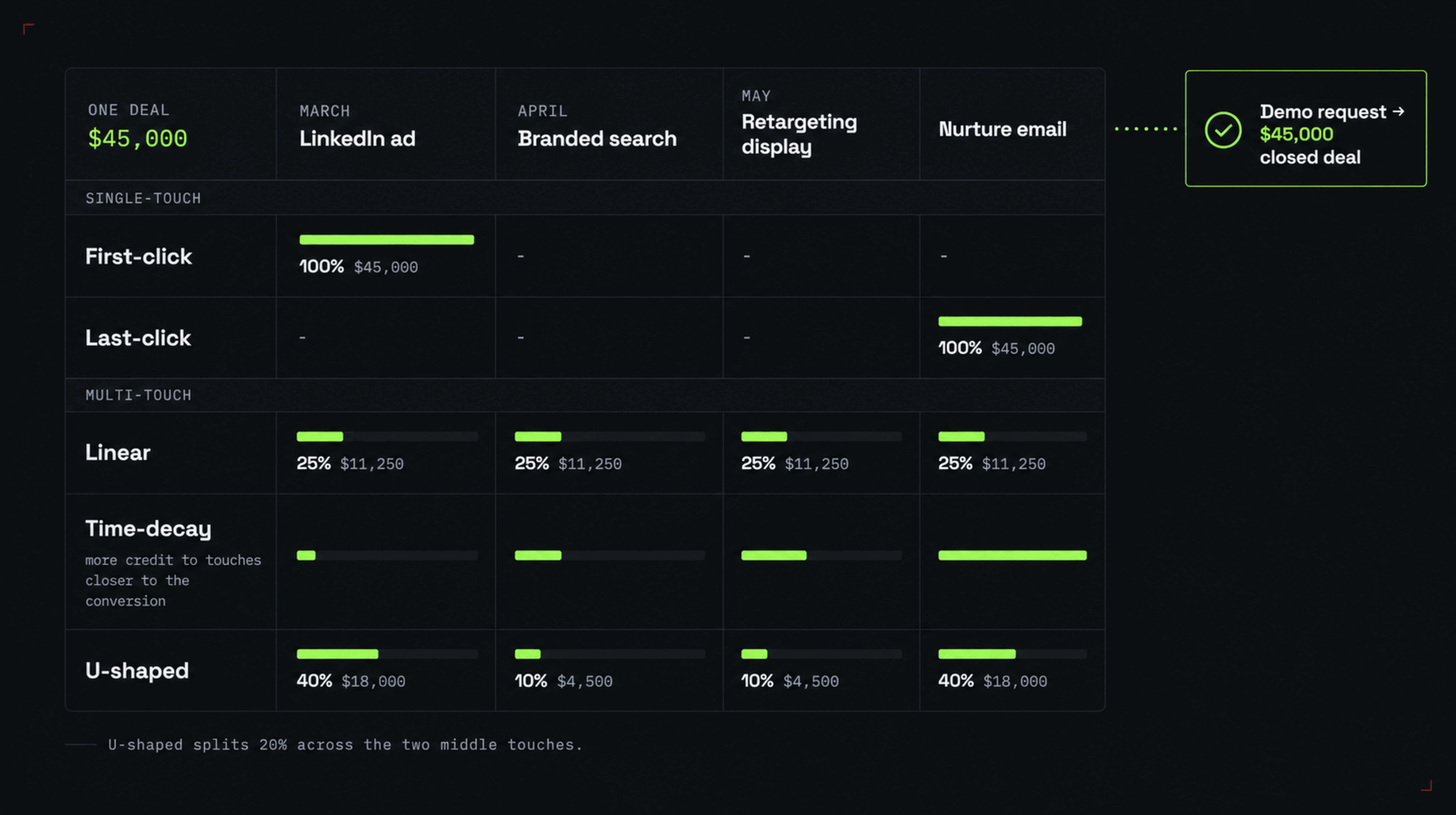
A buyer named Maya clicks a LinkedIn ad in March, runs a branded Google search in April, returns through a retargeting display ad in May, opens a nurture email, and finally books a demo that closes as a $45,000 deal. Which marketing touch earned the win? Depending on the rule you use, the answer is LinkedIn, or Google, or the nurture email, or some weighted blend. Marketing attribution models are the rules that decide. This guide walks the full spectrum, from the blunt single-touch models to algorithmic data-driven attribution, using one running journey so you can see exactly how the credit moves. By the end, you'll know what each model rewards, where it lies to you, and how to pick the right one for your sales cycle and channel mix.
What Are Marketing Attribution Models?
A marketing attribution model is the rule that decides how conversion credit gets split across the touchpoints a buyer hits on the way to converting. As Google's analytics documentation defines it, an attribution model "can be a rule, a set of rules, or a data-driven algorithm that determines how credit is assigned to touchpoints" along the path to a key action. Attribution itself is simply "the act of assigning credit for important user actions to different ads, clicks, and factors" along that path.
That definition sounds abstract until you apply it to Maya's four marketing touches: a LinkedIn ad, a branded search, a retargeting display ad, and a nurture email. The demo request is the conversion outcome, not another marketing touch eligible for credit. The attribution model is the accountant that divides one closed deal's worth of credit across the four actual touches. Change the accountant and the books read completely differently, which is why the choice matters more than it first appears.
The models sort into three families: single-touch (one touch takes all the credit), multi-touch (credit is shared across several touches by a fixed rule), and data-driven (an algorithm decides the split from your own conversion data). Most teams start at the single-touch end because it's simple, then move rightward as their data and questions get more sophisticated. That progression, from first-click to data-driven, is the maturity spectrum this guide follows.
Why Attribution Models Matter for Marketers
Pick the wrong model, and you defund the channels that actually create demand. Last-click attribution, still the most common default, hands every dollar of credit to the final eligible marketing touch before conversion. In Maya's journey, that's the nurture email that led to the demo request, which makes the closing channel look heroic and the LinkedIn ad that started everything look worthless. Cut the LinkedIn budget on that logic and next quarter's pipeline quietly dries up, because nothing is feeding the top of the funnel anymore.
Attribution is really a budget-allocation tool wearing a reporting disguise. Every model is an opinion about where return on investment comes from, and that opinion flows straight into spend decisions. When marketing and sales argue about which channels deserve more money, they're usually arguing about attribution without naming it.
The second job is alignment. A shared model gives marketing, sales, and finance a common reporting lens instead of three competing spreadsheets, so the conversation shifts from "whose number is right" to "what do we do about it." It isn't the truth, though: finance, sales, CRM, ad-platform, and analytics systems can still tell a different story, because each measures different events and windows.
There's a catch worth stating early: no model is objectively correct. Each is a deliberate simplification of a messy customer journey, and the right choice depends on your sales cycle, your channel mix, and how much clean data you have.
Single-Touch vs. Multi-Touch Attribution
The first real fork is whether one touchpoint gets all the credit or several share it. Single-touch attribution picks one touchpoint or event and lets it stand in for the rest, whether that's the first click, the last click, or another single interaction depending on the platform. Multi-touch attribution (sometimes called multi-channel attribution) distributes credit across the observable path, which mirrors how buyers actually behave but only captures what's instrumented: dark social, untagged links, cookie and identity gaps, offline touches, cross-device gaps, and platform-restricted impression data can all fall outside it.
The table below shows the trade-off in one view.
| Aspect | Single-Touch | Multi-Touch |
|---|---|---|
| Credit | 100% to one touch (first or last) | Split across many touches |
| Insight level | Low; sees a slice of the journey | Higher; captures more of the observable path, though added complexity can create false precision |
| Setup complexity | Low; easy to implement and explain | Higher; needs cross-channel tracking |
| Best for | Short journeys, quick reads, small channel mix | Longer B2B cycles, multi-channel programs |
| Key weakness | Over- or under-credits whole channels | Harder to stitch; can dilute credit evenly |
Single-touch isn't always the wrong call. If you run one or two channels and buyers convert fast, the extra precision of multi-touch may not change a single decision. But the moment a buyer like Maya has four marketing touches over two months, a single-touch model throws away 75% of the story: the view-through and assist touches that built her intent simply vanish from the report. That gap is the reason multi-touch models exist, and it's where most growing programs eventually land.
Single-Touch Attribution Models
Single-touch models answer one question: which single moment deserves the win? They're easy to set up and easy to explain to a skeptical CFO, which is why they remain the default in so many dashboards. The cost is tunnel vision: each model below sees exactly one touch in Maya's four-touch marketing journey and treats the other three as if they never happened.
First-Click (First-Touch) Attribution
First-click attribution gives 100% of the credit to the first touchpoint in the journey. For Maya, that's the LinkedIn awareness ad, which collects the entire $45,000 deal. This model is built to answer a top-of-funnel question: which channels are good at discovery and demand creation?
Used for that purpose, it's useful. Used as your only model, it can be dangerous, because it implies the closing channels did nothing. A first-click view rewards the ad that introduced you and ignores the email and demo that actually sealed it. Treat it as a demand-gen lens, not a verdict.
Last-Click (Last-Touch) Attribution
Last-click attribution is the mirror image: 100% of the credit goes to the final eligible marketing touch before conversion. Maya's nurture email takes everything because it precedes the demo request, and LinkedIn gets nothing. It's the long-time industry default because the last tracked interaction before conversion is usually the easiest one to connect to the outcome.
It also quietly distorts budgets. Last-click over-rewards branded search and bottom-funnel retargeting, the touches that show up right before a conversion that was already going to happen, while starving the awareness channels that created the demand in the first place. If your reports make brand search look like your best performer, last-click attribution is often the reason.
Last Non-Direct Click
Last non-direct click is a small but important fix to plain last-click. It ignores direct traffic and assigns 100% of the credit to the last channel the customer actually clicked through before converting. The logic is that someone typing your URL directly was already sold, so the marketing touch just before that deserves the credit instead.
This matters because direct traffic is a junk drawer. It catches bookmarks, dark social, and untagged links, so crediting it tells you nothing actionable. In Google Analytics 4, this isn't even a separate setting: Google Analytics 4's documentation notes that "Paid and organic last click and Last non-direct click are two names for the same attribution model." If you're going to run last-click at all, run the non-direct version.
Multi-Touch Attribution Models
Multi-touch models stop pretending one touch did all the work. They split credit across the journey using a fixed, rules-based formula, which gives you a fairer read on how channels work together to drive lead creation and revenue. The trade-off is that every multi-touch model still imposes a human assumption about which positions matter most. Watch how each one re-divides Maya's single $45,000 deal across her four marketing touches.
Linear Attribution
Linear attribution splits credit evenly across every eligible marketing touchpoint. Maya's four touches each get 25%, or $11,250 of the deal. It's the fairest-sounding model and the easiest to defend in a meeting, because nobody can accuse it of playing favorites. It avoids the first- and last-touch bias baked into single-touch models, but equal weighting is a bias of its own.
Its weakness is the flip side of its fairness: it treats a throwaway impression exactly like the nurture email immediately before the demo request. Real journeys aren't egalitarian, and linear pretends they are. It's a reasonable starting point for teams that want every touch visible without arguing about weights yet.
Time-Decay Attribution
Time-decay attribution gives more credit to marketing touches closer to the conversion and less to the early ones. Maya's nurture email carries the most weight, followed by the retargeting display ad, while the March LinkedIn ad earns a sliver. The reasoning is that recent interactions are more strongly associated with the decision to buy.
That makes time-decay a good fit for short sales cycles, where recency correlates with intent. For a long B2B cycle, it can undervalue the awareness work that did the heavy early lifting, so match it to how fast your buyers actually move.
Position-Based (U-Shaped) Attribution
Position-based attribution, also called U-shaped, is the popular compromise. It commonly gives 40% of the credit to the first marketing touch, 40% to the last, and splits the remaining 20% across the middle touches, though the exact split isn't fixed by the concept itself. For Maya, LinkedIn and the nurture email each take $18,000, while branded search and retargeting display each receive $4,500.
The model encodes a real belief: the touch that introduced the buyer and the touch that closed them matter most, with everything between playing a supporting role. For B2B lead generation, where the first ad and the final demo really are pivotal, that assumption holds up well. "50/50 attribution" is the informal cousin of this idea, splitting credit evenly between just the first and last touch when the middle is ignored.
W-Shaped Attribution
W-shaped attribution extends the U-shape with a third anchor, loading roughly 30% each onto three milestone touches, commonly the first touch, the lead-creation touch, and the opportunity-creation touch, then spreading the remaining 10% across everything else. It's a B2B convention for teams that track the funnel by CRM stage, and it grows more accurate as those milestones get cleaner.
Custom / Weighted Attribution
Custom attribution throws out the preset formulas and lets you assign your own weights by channel and position, useful if LinkedIn punches above its weight for your audience. Several platforms, including the best multi-touch attribution tools, support custom weighting for this reason. The tradeoff is that you're baking your own biases into the math, so revisit the weights as you learn, or the model drifts out of date.
Data-Driven (Algorithmic) Attribution
Data-driven attribution, sometimes called algorithmic attribution, hands the credit-splitting decision to machine learning instead of a human rule. Rather than asserting that the first and last touch matter most, it learns the answer from your own conversion paths. Google Analytics 4 describes its version this way: it "uses your account's data to calculate the actual contribution of each click interaction."
The mechanism is different in kind from the rules-based models. GA4's algorithm "evaluate\[s\] both converting and non-converting paths" using a counterfactual approach, comparing what happened with what could have happened to estimate which touchpoints appear to contribute to a conversion, rather than which ones actually caused it. In Maya's case, the model wouldn't assume her LinkedIn ad mattered; it would check whether buyers who saw that ad converted more often than comparable buyers who didn't, then assign credit based on the measured lift.
This is also where a major shift caught a lot of teams off guard. In Google Analytics 4, the classic rules-based models were retired: per Google's documentation, "the first click, linear, time decay, and position-based attribution models are no longer available as of November 2023," leaving just data-driven and two last-click variants. That deprecation is specific to GA4, not the industry at large, so the classic models still live on in dedicated attribution tools. But if you assumed you could still pick linear inside GA4, that's why you can't.
Data-driven attribution is the most sophisticated end of the spectrum, and it isn't free of trade-offs. It needs a meaningful volume of conversion data to produce stable results, and because each model is specific to one account and key event, its conclusions don't transfer between properties or between companies. When data volume is thin, a transparent rules-based model often beats a hungry algorithm starved of examples. If you want to feed it cleaner cross-channel signals, the practical first step is to connect your ad platforms. That widens the observable signal considerably, though privacy limits, walled gardens, and missing identifiers mean it's still not a literal whole journey.
How to Choose the Right Attribution Model
There's no universally best model, so stop hunting for one. The right choice comes from three questions about your business, and the answer is usually to compare a few models rather than commit to one.
First, how long is your sales cycle? Short, transactional journeys reward recency, which points to last-click or time-decay. Long, considered B2B cycles spread influence across many touches over weeks or months, which is where U-shaped, W-shaped, and data-driven models earn their keep. Match the model to how your buyers actually move, not to what's easiest to report.
Second, how many channels do you run? A one- or two-channel program can survive on a single-touch model because there isn't much journey to misattribute. The moment you're running paid across Google, LinkedIn, Microsoft, Reddit, and beyond, single-touch starts hiding the interactions that matter, and you need a multi-touch view to see how those channels work together.
Third, how mature is your data? Data-driven attribution rewards teams with clean, high-volume conversion data and offline channels stitched in. If your tracking is patchy or your volume is low, a transparent rules-based model you can explain beats a black box you can't trust yet. Be honest about which camp you're in.
The practical move is to look at the same journey through several models at once, since the disagreements between them are where the insight lives. If first-click loves LinkedIn but last-click ignores it, that tension tells you LinkedIn is an opener, not a closer, and you should fund it accordingly. The usual blocker is plumbing: comparing models means manually stitching ad-click data to web sessions to CRM records, which is the work most teams never finish. This is where an ad operator with multi-touch attribution built into the platform can change the equation. Synter compares first-click, last-click, linear, time-decay, U-shaped, and custom weighted models side by side, stitches ad clicks to website sessions to CRM deals automatically, and syncs natively with HubSpot and Salesforce to attribute revenue rather than raw conversions. Because that attribution lives next to the bidding engine instead of in a separate report, an under-credited channel can have budget shifted toward it in the same workflow. It's one example of the broader category of attribution software for marketing teams that aims to close the gap between measuring and acting.
One caveat: putting models side by side doesn't erase the data-volume requirement of the algorithmic ones. Tooling makes the comparison easy, but a data-driven model still needs enough conversions to be trustworthy, whoever runs it.
One more distinction worth keeping straight: attribution assigns credit; it doesn't estimate causal lift. That's what incrementality testing is for. For major budget decisions, especially brand, search, and retargeting debates, validate attribution with holdouts, geo tests, or controlled experiments where possible.
Conclusion
Marketing attribution models are opinions about where credit belongs, ranging from the blunt single-touch verdicts to the algorithmic nuance of data-driven attribution. First-click celebrates discovery, last-click rewards the close, the multi-touch models share the credit by rule, and data-driven lets your own data settle the argument. None of them is the truth; each is a useful lens, and the one that fits depends on your sales cycle, your channel mix, and your data maturity.
The most useful habit isn't picking a single winner: it's comparing models on the same journey and acting on where they disagree. If you'd rather not hand-stitch ad, web, and CRM data to run that comparison, you can see how we run every model side by side on our attribution feature page, then review the current plans.
Frequently Asked Questions
What are the four types of attribution? Four commonly cited types are first-touch, last-touch, linear, and time-decay. Position-based and data-driven attribution are additional models teams often evaluate as their measurement matures.
Which is the best attribution model? There isn't one. It depends on your sales-cycle length, channel mix, and data maturity, as covered above.
What is 50/50 attribution? It's an informal name for splitting conversion credit evenly between the first and last touchpoint, 50% each, ignoring the middle: the simple cousin of position-based (U-shaped) attribution's common 40/40/20 split.
What is the GA4 attribution model? Google Analytics 4 offers three models: data-driven attribution plus two last-click variants, after first-click, linear, time-decay, and position-based were retired in November 2023.