TL;DR
- Cross-platform advertising means coordinating campaigns across multiple ad platforms with unified strategy, budget, and attribution — not managing each in isolation
- The fragmentation problem: Your buyers are on Google, LinkedIn, Reddit, TikTok, and Meta simultaneously. No single platform reaches them all
- Synter performance data: -46% CPA, +133% CTR, -61% CPL vs. single-platform campaigns
- The modern approach: AI Agents that translate one brief into platform-native campaigns across 20+ platforms — no tab switching, no manual replication
- Key platforms in 2026: Google Ads, Meta, LinkedIn, Microsoft Ads, Reddit, TikTok, X Ads, Amazon Ads, StackAdapt, The Trade Desk, Spotify Ads
1. What is Cross-Platform Advertising?
Cross-platform advertising is the practice of running coordinated ad campaigns across multiple ad platforms simultaneously — with unified strategy, consistent messaging, and shared budget orchestration.
The key word is coordinated. Running isolated campaigns on Google and Meta is not cross-platform advertising. Cross-platform advertising means:
- A single campaign brief that informs creative and targeting across every platform
- Budget that shifts dynamically to the channels delivering the best performance
- Unified attribution so you understand how platforms work together, not just in isolation
- Consistent naming conventions and UTM parameters for clean reporting
- Synchronized creative testing across platforms to find what resonates
The distinction matters because fragmented, siloed ad management creates conflicting signals. You may be retargeting the same person on three platforms with three different messages. You may be paying premium CPMs on LinkedIn for the same audience you already captured at $0.50 CPC on Reddit. Cross-platform advertising eliminates these inefficiencies by treating your entire media mix as one system.
The Scale of Fragmentation
In 2026, the average B2B buyer consumes content across 6.4 different platforms before making a purchase decision. No single ad platform has more than 35% penetration of your full addressable audience. If you're only on one or two platforms, you are structurally invisible to the majority of your market.
Cross-Platform vs. Cross-Channel vs. Omnichannel
These terms are used interchangeably, but there are meaningful differences worth understanding:
| Term | Scope | What it includes |
|---|---|---|
| Cross-Platform | Paid media | Coordinating campaigns across paid ad platforms (Google, Meta, LinkedIn, TikTok, etc.) |
| Cross-Channel | Broader marketing mix | Paid + organic + email + content + events in one unified strategy |
| Omnichannel | Full customer experience | Marketing + sales + product + support across every touchpoint |
This guide focuses on cross-platform advertising — specifically the coordination of paid media campaigns across multiple ad platforms. For most marketing teams, this is the highest-return problem to solve first, because it delivers the most direct impact on cost-per-acquisition without requiring changes to your entire go-to-market motion.
The 10+ Platform Reality of 2026
The number of viable ad platforms has expanded dramatically. In 2020, most companies could reasonably cover their audience with Google + Facebook. In 2026, the landscape looks like this:
| Platform | Primary Use Case | Audience Strength |
|---|---|---|
| Google Ads | High-intent search, Shopping, YouTube | In-market buyers actively searching |
| Meta Ads | Awareness, retargeting, lookalike audiences | Broad consumer + SMB reach |
| LinkedIn Ads | B2B demand gen, Lead Gen Forms, ABM | Decision-makers by title, seniority, company |
| Microsoft Ads | Bing search + LinkedIn audience targeting | Enterprise buyers, older demographics |
| Reddit Ads | Community-based research phase targeting | Developers, tech enthusiasts, niche communities |
| TikTok Ads | Video discovery, Gen Z + Millennial awareness | Younger buyers in discovery mode |
| X (Twitter) Ads | Thought leadership, event-based targeting | Tech, finance, media professionals |
| Amazon Ads | Product search, retail media | Purchase-ready shoppers |
| Amazon DSP | Programmatic display + video, audience extension | Amazon audience data off-platform |
| StackAdapt | Programmatic native, display, video | B2B + consumer programmatic |
| The Trade Desk | Enterprise programmatic, CTV, audio | Premium publisher inventory |
| Spotify Ads | Audio advertising, podcast adjacency | Streaming listeners by context + interest |
2. Why Cross-Platform Advertising Matters in 2026
Four structural forces are making cross-platform advertising non-negotiable for growth-oriented companies in 2026.
Audience Fragmentation
Attention has fractured across a dozen platforms. TikTok has become a primary search engine for Gen Z. Reddit dominates developer-focused product research. LinkedIn is the primary discovery surface for enterprise B2B. Google Search remains the highest-intent channel. Your buyers exist on all of them — you have to be present on all of them.
Attribution Complexity
iOS 14.5+ shattered last-click attribution. Browser privacy restrictions have eroded pixel-based tracking. Third-party cookies are in structural decline. Without cross-platform coordination, you cannot reconstruct a coherent view of the buyer journey. You end up with conflicting platform-reported conversions and no ground truth.
Platform Algorithm Maturity
Each platform's algorithm has become extraordinarily good at finding its specific type of user. Google finds high-intent searchers. LinkedIn finds decision-makers by title and seniority. Reddit finds people actively researching a topic. No single algorithm can replicate what the full ecosystem provides. The arbitrage is in combining them intelligently.
Creative Fatigue
Audiences on single-platform campaigns experience creative fatigue faster. When you distribute budget across 4–6 platforms, each individual user sees your ads less frequently per platform — reducing fatigue while maintaining cumulative reach. This structural diversity also gives your creative team real signal on what resonates across different contexts.
The Platform Monopoly Myth
A common objection: "We get 80% of our leads from Google — why complicate things?" The answer is that Google-only attribution is almost certainly overcounting. If a buyer sees your LinkedIn ad, searches your brand on Google, and converts — Google claims 100% of that credit. Your LinkedIn campaign looks like it "didn't work." Cross-platform attribution reveals the true assist structure of your media mix and almost always shows that the lead journey started somewhere other than Google.
The Tab Hell Problem
Before discussing strategy, it's worth naming the operational reality that makes cross-platform advertising so difficult in practice: tab hell.
A media buyer operating 5 platforms simultaneously has 5 separate logins, 5 different campaign builders, 5 sets of reporting dashboards, 5 formats of performance export, and 5 proprietary campaign structures to learn and maintain. Launching a single campaign across all five takes an estimated 2–3 full business days of manual work. Reporting requires stitching together spreadsheet exports from each platform. A single budget reallocation decision requires logging into every platform individually and making the change by hand.
This execution overhead is why most companies don't do cross-platform advertising properly — not because the strategy doesn't work, but because the operational cost of doing it manually is prohibitive. This is the core problem that AI Agents are built to solve.
3. Benefits of Cross-Platform Campaigns in Online Advertising
The business case for cross-platform advertising is well-established. Here is what Synter sees across customers who move from single-platform to coordinated multi-platform campaigns:
Cost Per Acquisition
Click-Through Rate
Cost Per Lead
These figures emerge consistently because cross-platform campaigns benefit from four compounding advantages:
1. Audience Completion
No single platform reaches your entire addressable market. Google captures people actively searching for your category. LinkedIn reaches decision-makers during their professional browsing. Reddit reaches people researching alternatives. TikTok reaches buyers in discovery mode. Combined, these platforms cover dramatically more of your total addressable audience than any single channel. If your buyer is a VP of Engineering at a 500-person company, they are on Google searching for solutions, on LinkedIn receiving InMail, on Reddit reading product reviews, and on X following developer influencers — all in the same week.
2. Budget Efficiency Through Platform Arbitrage
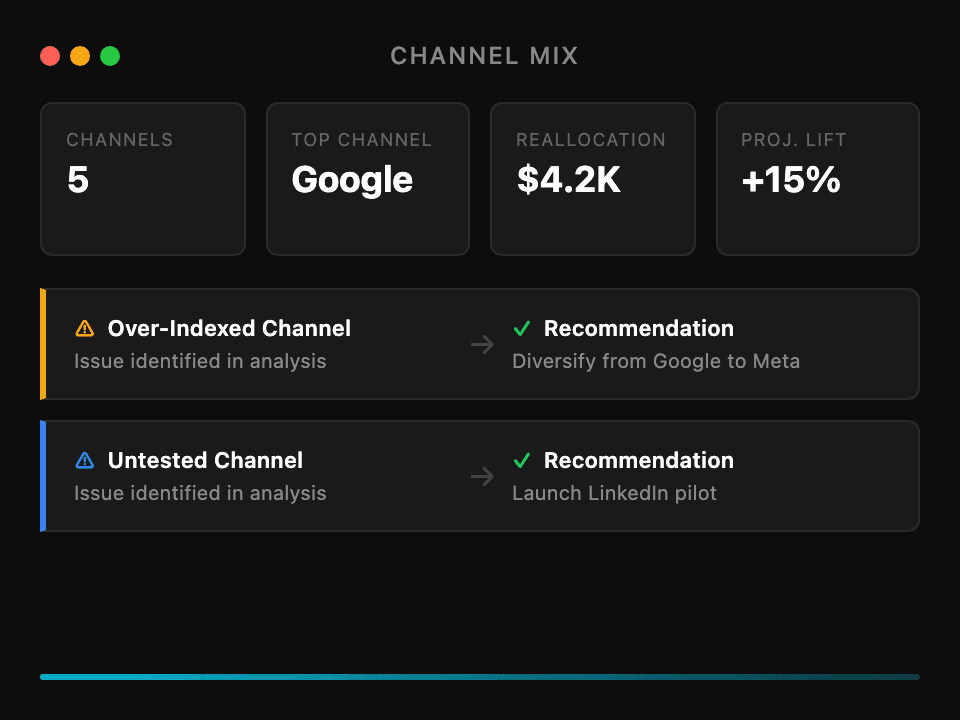
Different platforms have wildly different CPMs for equivalent audiences. LinkedIn might charge $80 CPM for a VP-of-Engineering audience. Reddit might deliver the same developer audience at $12 CPM through subreddit targeting. Google Display might reach them at $4 CPM. Cross-platform management surfaces these discrepancies and shifts budget to the most efficient platform for each audience segment — a structural cost advantage that single-platform campaigns cannot access.
3. Creative Signal Acceleration
Running creative tests across 5 platforms simultaneously generates 5x the volume of signal in the same timeframe. A message that underperforms on Meta might resonate strongly on LinkedIn. A headline that wins on Reddit might become your Google search ad. Cross-platform creative testing reveals which value propositions work in which contexts — insights that improve every platform's performance over time.
4. Reduced Attribution Blind Spots
Coordinated cross-platform campaigns with consistent UTM structures and server-side conversion tracking reconstruct the buyer journey more accurately. You can see the full assist structure — which platforms influence awareness, consideration, and conversion — rather than assigning 100% credit to the last click. This leads to better budget allocation decisions and reveals which platforms are genuinely driving pipeline vs. which are just claiming credit.
The compounding effect: Cross-platform advertising benefits compound over time. Month 1 delivers broader reach. Month 2 reveals which platforms are genuinely efficient. Month 3 opens budget reallocation to best performers. By Month 6, your media mix has been empirically calibrated in a way that single-platform campaigns can never achieve — because you have real comparative data across platforms for the same audience and offer.
4. Cross-Platform Advertising Strategy
A cross-platform advertising strategy is not just "run ads on more platforms." It is a structured framework for coordinating budget, creative, targeting, and measurement across your entire media mix. Here is the step-by-step framework Synter customers use:
Step 1: Map Your Audience to Platforms
Start by understanding where your buyers actually spend time, not where you assume they are. Different buyer personas concentrate on different platforms based on their role, behavior, and intent state:
| Buyer Type | Primary Platforms | Why |
|---|---|---|
| Enterprise B2B (CTO, VP Eng) | LinkedIn, Google Search, Reddit | Professional browsing, high-intent search, developer communities |
| SMB Founders | Meta, Google Search, X (Twitter) | Facebook Groups, branded search, thought leadership feeds |
| Developer / Technical | Reddit, Google Search, X (Twitter) | r/programming, r/devops, GitHub discussions, tech Twitter |
| E-commerce Consumer | Meta, TikTok, Google Shopping, Amazon | Social discovery, short video, purchase intent search, marketplace |
| Healthcare / Regulated | Google Search, LinkedIn, Spotify | High-intent search, professional targeting, audio |
Step 2: Assign Funnel Roles by Platform
Not every platform serves every funnel stage equally well. A disciplined cross-platform strategy assigns each platform a primary funnel role rather than trying to run full-funnel on every platform simultaneously:
Top of Funnel — Awareness
- • TikTok (video discovery)
- • Meta (broad audience reach)
- • Spotify (audio branding)
- • The Trade Desk (programmatic display)
- • StackAdapt (native content)
Middle of Funnel — Consideration
- • LinkedIn (B2B decision-makers)
- • Reddit (research phase)
- • Microsoft Ads (Bing + LinkedIn targeting)
- • X Ads (thought leadership)
- • Amazon DSP (competitive retargeting)
Bottom of Funnel — Conversion
- • Google Search (high-intent queries)
- • Google Shopping (product-specific)
- • Amazon Ads (purchase-ready buyers)
- • Meta retargeting (warm audience)
- • LinkedIn Lead Gen Forms
Step 3: Define a Unified Creative Brief
Cross-platform advertising does not mean running the same creative everywhere. It means starting from one unified brief — your core message, value proposition, and audience insight — and adapting it for each platform's format, tone, and audience context.
The Brief-First Principle
Your creative brief should define: (1) the core problem you solve, (2) the buyer you're speaking to, (3) the one thing you want them to believe or do, and (4) proof points that make it credible. Every platform execution derives from this brief — ensuring message consistency even as format and tone adapt to each platform's culture and specs.
Concretely: a Google Search ad communicates your value proposition in 30-character headlines with no visual. A LinkedIn Sponsored Content ad pairs a 600-character intro with an image and a professional-context message. A Reddit ad adopts conversational, community-native copy. A TikTok ad shows rather than tells. All four derive from the same brief — they are not four separate creative strategies.
Step 4: Build a Cross-Platform Budget Framework
Budget allocation across platforms should be dynamic, not fixed. Start with a hypothesis, run for 30 days, then rebalance based on CPA by platform. Common starting allocations by company type:
| Company Type | Meta | Other | ||
|---|---|---|---|---|
| B2B SaaS (SMB) | 35% | 25% | 25% | 15% (Reddit, X) |
| B2B SaaS (Enterprise) | 30% | 40% | 15% | 15% (Microsoft, Reddit) |
| B2C E-commerce | 25% | 5% | 40% | 30% (TikTok, Amazon) |
| Developer Tool | 30% | 20% | 10% | 40% (Reddit, X, Spotify) |
Step 5: Establish Unified Measurement
Cross-platform campaigns require cross-platform measurement. Platform self-reported conversions will always overcount — each platform claims credit for conversions that span multiple touchpoints. A rigorous cross-platform measurement approach includes:
- Consistent UTM parameters across all platforms for source-of-truth attribution in GA4 or your analytics layer
- Server-side conversion APIs (Google Enhanced Conversions, Meta CAPI, LinkedIn Insight Tag) for signal that survives browser restrictions and ad blockers
- Incrementality testing — geo holdouts or platform-blackout tests — to measure true incremental lift per platform rather than correlational credit
- Normalized reporting that compares platforms on equivalent metrics rather than native platform metrics (Google CTR and LinkedIn CTR are fundamentally different numbers and should never be compared directly)
5. Cross-Platform Advertising Tools Comparison
The market for cross-platform advertising tools has matured significantly, but most tools solve only one piece of the problem. Here is a structured overview of the landscape organized by category:
Category 1: Bid Management Platforms
These tools focus on bid optimization and budget pacing across search and retail platforms. They were built for the pre-social-ads era and their architecture reflects that lineage. Strong for large-scale search; limited for social and emerging platforms.
| Tool | Platforms | Strength | Limitation |
|---|---|---|---|
| Skai (formerly Kenshoo) | Google, Microsoft, Amazon, Apple | Cross-search bidding, retail media | Limited social; high implementation cost |
| Marin Software | Google, Microsoft, Meta, Amazon | Enterprise-scale bid management | Complex setup; not agent-native |
| SA360 (Google) | Google, Microsoft, Yahoo Japan | Native Google integration | Google-ecosystem only; no social platforms |
Category 2: Reporting and Analytics
These tools aggregate performance data from multiple platforms into unified dashboards. They solve the reporting problem but do not execute campaigns — you still need to log into each platform to make changes.
| Tool | Strength | Limitation |
|---|---|---|
| Supermetrics | Wide connector library; works with any BI tool | Read-only; no campaign execution |
| Triple Whale | E-commerce attribution; Shopify-native | E-commerce focused; limited B2B platform support |
| Northbeam | Multi-touch attribution modeling | Reporting only; no activation layer |
Category 3: Creative Management
These tools help produce and serve creative assets across platforms. They sit upstream of campaign management and do not handle targeting, bidding, or budget orchestration.
| Tool | Strength | Limitation |
|---|---|---|
| Smartly.io | Social creative at scale; automated A/B testing | Social-focused; does not cover search or Amazon |
| AdCreative.ai | AI image generation for display ads | Creative production only; no campaign management |
| Celtra | Dynamic creative optimization | Enterprise pricing; creative-only scope |
Category 4: AI Agent Operator Platforms
The newest and most differentiated category. These platforms use AI Agents to execute campaign actions — not just report on them. They sit above all individual platform tools and operate them via Direct API connections, providing a single conversational interface for cross-platform campaign management.
The Operator Layer
An operator platform is not a dashboard or a reporting tool. It is an AI Agent that can actually do things — create campaigns, adjust bids, write and upload creative, add negative keywords, shift budget — across every platform from a single interface. This is a fundamentally different category from bid managers and analytics tools. The distinction is execution vs. observation.
| Platform | Platforms Supported | Execution | AI Agent Interface |
|---|---|---|---|
| Synter | Google, Meta, LinkedIn, Microsoft, Reddit, TikTok, X, Amazon, Amazon DSP, StackAdapt, The Trade Desk, Spotify | Full create / edit / pause / budget / bid / creative | Yes — Campaign IDE (conversational) |
| Skai | Google, Microsoft, Amazon, Apple | Bid management + reporting | Rule-based automation only |
| Marin | Google, Microsoft, Meta, Amazon | Bid management + reporting | Rule-based automation only |
| Smartly.io | Meta, TikTok, Snapchat, Pinterest | Creative serving + social bid management | Creative automation; no agent reasoning |
6. Cross-Platform Advertising Examples
Here are three real-world examples of cross-platform advertising from Synter customers — illustrating how different companies structure their media mix and why each platform serves a distinct strategic purpose.
Sourcegraph — Developer Tooling, B2B SaaS
Sourcegraph — the code intelligence platform used by large engineering teams — runs a cross-platform strategy specifically engineered for developer audiences, who are notoriously difficult to reach through traditional B2B advertising channels.
- Google Ads: High-intent search for queries like "code search tool," "code intelligence platform," and "enterprise code review" — capturing developers actively evaluating solutions for their team
- Reddit Ads: Subreddit targeting across r/programming, r/devops, r/MachineLearning, and r/softwareengineering — reaching developers in the research phase with community-native ad formats that match the platform's conversational tone
- LinkedIn Ads: Firmographic targeting on Engineering Managers, Staff Engineers, and CTOs at companies with 500+ engineers — hitting the economic buyer while developers build bottom-up adoption
- X Ads: Promoted content targeting followers of engineering thought leaders and developer influencers — building brand presence in the developer conversation layer where career decisions are publicly discussed
Result: Developer-focused cross-platform strategy maintains presence across the full research journey — from discovery to evaluation to purchase approval — covering all three layers of the typical enterprise developer tool buying committee.
AudioEye — Accessibility SaaS, B2B
AudioEye — the digital accessibility platform — operates in a compliance-driven category where buyer intent is often triggered by legal events, audit findings, or executive directives. Their cross-platform mix reflects this purchase trigger structure:
- Google Ads: High-intent search targeting compliance queries ("ADA website compliance," "WCAG audit tool," "web accessibility checker") — capturing buyers with immediate compliance urgency
- LinkedIn Ads: VP and Director-level targeting in Legal, Compliance, and Digital roles at enterprise organizations — reaching decision-makers before the compliance event triggers, building awareness so AudioEye is already known when the need arises
- Microsoft Ads: Bing search + LinkedIn audience overlap — capturing the enterprise buyer who uses Microsoft-native tools and is often an edge case that Google-only campaigns underserve, particularly in government and regulated industries
- Reddit Ads: Subreddit targeting in web development and design communities — reaching developers who will advocate for accessible builds within their organization and influence the technical evaluation
Result: Cross-platform strategy reaches the accessibility buyer through multiple entry points — legal trigger capture, executive awareness, and developer advocacy — reflecting the true buying committee structure for compliance software.
bolt.new — Developer Platform, PLG
bolt.new — the AI development environment — uses a product-led growth (PLG) model where developers discover, try, and adopt the product before enterprise procurement gets involved. Their cross-platform strategy is structured around developer discovery behaviors:
- TikTok Ads: Video content showing real developer workflows and product demos — reaching younger developers in discovery mode with native-format demonstrations that match how they consume content on the platform
- Reddit Ads: Developer subreddit targeting with authentic, community-tone ads in r/webdev, r/javascript, and r/ChatGPT — leveraging the fact that developers research new tools on Reddit before trying them and trust peer recommendations within communities
- X Ads: Promoted posts targeting developer audiences and followers of developer influencers — amplifying organic developer conversation and riding the social proof structure of developer Twitter/X
- Google Ads: Brand and competitive keyword capture — ensuring developers who heard about bolt.new through TikTok, Reddit, or X can find it immediately when they search to validate or try it
Result: Discovery-first cross-platform strategy matches the PLG motion — reach developers where they discover new tools, then capture them when they search. Each platform plays a specific role in the developer journey from discovery to activation.
Notice the structural pattern across all three examples: each company has a primary platform for high-intent capture (usually Google Search) and a set of discovery and consideration platforms tuned to their specific audience type. The mix is not arbitrary — it is derived from a clear understanding of where each buyer persona spends time and what they are doing there.
7. How Synter's Campaign IDE Handles Cross-Platform Advertising
Synter's Campaign IDE is a conversational interface where AI Agents execute cross-platform campaigns end-to-end. The architecture addresses every layer of the cross-platform problem — from strategy translation to execution to unified reporting.
Direct API Connections to 20+ Platforms
Synter connects directly to ad platform APIs — no middleware, no sync delays, no third-party connectors that break when platforms update their APIs. This means real-time data, real-time execution, and no information loss between your intent and what ships.
How a Cross-Platform Campaign Ships in Minutes
Step 1: Connect Your Platforms
OAuth connections to all your ad accounts in one place. AI Agents get read/write access to create campaigns, pull performance data, and execute changes. Tokens are encrypted and access can be revoked anytime. This is a one-time setup that takes about 10 minutes per platform.
Step 2: Describe Your Strategy in Natural Language
Tell Campaign IDE what you want: "Launch a campaign for our API monitoring product targeting senior engineers at Series B+ companies. $15K/month budget. Operate for demo requests. We want to be on Google, LinkedIn, and Reddit."
The AI Agent understands your brief and translates it into a cross-platform execution plan with platform-specific targeting recommendations, budget splits, and creative direction.
Step 3: AI Agents Build Platform-Native Campaigns
The agent translates your brief into campaigns for each platform — respecting each platform's campaign structure, targeting taxonomy, creative specs, bidding strategies, and character limits. No copying and pasting. No reformatting. The agent knows that LinkedIn uses Campaign Groups, Google uses Campaign/Ad Group hierarchies, Reddit uses Campaign/Ad Group, and that targeting works completely differently across all of them.
Step 4: Dry-Run Validation Before Spending
Synter's dry-run mode uses actual platform API calls to validate your campaigns — catching targeting errors, budget misconfigurations, creative policy violations, and audience size issues before a single dollar is spent. This is not a simulation. It is real API validation without committing the campaign. The dry-run catches the types of errors that previously required manual QA across five different platform UIs.
Step 5: One-Approval Launch and Unified Reporting
Approve the plan. The agent ships campaigns across all platforms simultaneously. Performance data flows back into Campaign IDE as a unified view — no switching between platform dashboards, no spreadsheet stitching. Ask the agent "how is Reddit performing vs. LinkedIn for CPL this week?" and get an instant answer drawn from live API data.
Platform-Specific Intelligence at Scale
The meaningful difference between an AI Agent and a human doing this manually is not just speed. The agent maintains complete, accurate knowledge of every platform's mechanics and translates concepts without loss:
| Concept | Google Ads | Meta | ||
|---|---|---|---|---|
| Campaign Structure | Campaign → Ad Group → Ad | Campaign Group → Campaign → Creative | Campaign → Ad Set → Ad | Campaign → Ad Group → Ad |
| Primary Targeting | Keywords, Audiences | Job Title, Company, Industry, Seniority | Interests, Lookalikes, Custom Audiences | Subreddits, Interests, Keywords |
| Bidding Options | Target CPA, Max Clicks, Target ROAS | CPC, CPM, Daily/Total budget | Lowest Cost, Cost Cap, Bid Cap | CPC, CPM, CPV |
| Unique Strength | High-intent search | B2B firmographic precision | Scale + lookalike modeling | Community context targeting |
Governance, Explainability, and Rollback
Every action the AI Agent takes is logged with a natural language explanation: what changed, why, and what data informed the decision. Any change can be rolled back instantly. Budget guardrails — hard limits on platform spend — cannot be overridden by the agent. High-impact changes (pausing a top-spending campaign, major budget reallocations) can be configured to require explicit human approval before execution.
Explainable AI Execution
Synter is not a black-box automation tool. Every agent action surfaces its rationale in plain language. When the agent shifts $2,000 from LinkedIn to Reddit, you see exactly why: "Reddit CPL is $47 vs. LinkedIn CPL of $312 over the last 14 days for this audience segment." You stay in control. The agent handles execution. This is what "Autonomous AI Execution" actually means in practice — not a black box that makes decisions you can't inspect, but an agent that acts, explains, and defers to human judgment on high-stakes decisions.
8. Getting Started with Cross-Platform Advertising
The highest-impact starting point for most teams is not running ads on more platforms — it is properly coordinating the platforms you already use. Here is the recommended path:
- Audit your current platform mix
Where are you currently spending? What is your CPA, CTR, and CPL on each platform independently? Are you using consistent UTM parameters? Do you have server-side conversion tracking configured? Answer these questions before adding new platforms — you need a measurement baseline to evaluate what you add.
- Map your audience to 2–3 new platforms
Use the buyer-type matrix from Section 4 to identify which platforms you are missing. Pick 2–3 to test, not all of them at once. Common expansions: Google-only companies adding LinkedIn and Reddit; Meta-only companies adding Google Search and TikTok; LinkedIn-heavy B2B companies adding Reddit and Microsoft Ads.
- Write a unified creative brief
Before shipping anything, write the brief. Core problem, target buyer, the one thing you want them to believe, and your proof points. Every platform execution derives from this document. This step is what makes your cross-platform campaigns coordinated rather than just parallel.
- Connect your platforms and ship
If you are using Synter, connect your ad accounts via OAuth and describe your campaign in Campaign IDE. The AI Agent builds platform-native campaigns, validates them via dry-run, and ships them with one approval. If you are doing this manually, budget 3–5 days for initial setup across 3 platforms — and plan for ongoing maintenance overhead.
- Measure and rebalance after 30 days
Pull platform-normalized performance data after 30 days. Compare CPA and CPL by platform using your source-of-truth analytics, not platform-reported numbers. Shift budget toward the most efficient platforms. This monthly rebalancing cycle is where the compounding advantage of cross-platform advertising builds over time.
Synter connects to 20+ ad platforms, including Google Ads, Meta Ads, LinkedIn Ads, Microsoft Ads, Reddit Ads, TikTok Ads, X Ads, Amazon Ads, StackAdapt, The Trade Desk, Spotify Ads, and more. Describe your strategy once. AI Agents ship to every platform. Start Growing or book a demo.
9. Frequently Asked Questions
What is cross-platform advertising?
Cross-platform advertising is the practice of running coordinated ad campaigns across multiple ad platforms simultaneously — such as Google Ads, Meta, LinkedIn, TikTok, Reddit, and Amazon — with unified strategy, messaging, and budget orchestration. Rather than managing each platform in isolation, cross-platform advertising treats all channels as a single, connected system.
What are the benefits of cross-platform campaigns in online advertising?
The primary benefits include wider audience reach (different audiences live on different platforms), reduced cost-per-lead through budget reallocation to best-performing channels, consistent brand messaging across touchpoints, better attribution through unified reporting, and faster creative testing across audiences. Synter customers see an average 46% reduction in CPA when moving from single-platform to cross-platform campaigns.
What tools are used for cross-platform ad management?
Cross-platform ad management tools fall into four categories: bid management platforms (Skai, Marin), reporting and analytics layers (Supermetrics, Triple Whale), creative management platforms (Smartly.io, AdCreative.ai), and AI Agent operator platforms that execute across all platforms via Direct API connections. Synter sits in the operator category — AI Agents that plan, build, and ship campaigns across 20+ platforms from a single conversational interface.
How many platforms should I advertise on?
Most B2B companies start with 2–3 platforms (typically Google + LinkedIn, or Google + Meta) and expand based on performance data. B2C companies often run on 3–5 platforms simultaneously. The optimal number depends on your audience distribution, budget scale, and creative bandwidth. With AI Agents handling execution, the incremental overhead of adding a platform is minimal.
Related Reading
What is Agentic Advertising?
The complete guide to AI Agents that autonomously plan, buy, and optimize digital ad campaigns across platforms.
Google Ads AI Agent: Complete Guide
Deep dive into AI Agents for Google Ads — keyword research, bid management, negative keyword mining, and Quality Score optimization.
LinkedIn Ads AI Agent Guide
How AI Agents handle firmographic targeting, Lead Gen Forms, and ICP fit scoring on LinkedIn.
Reddit Ads Guide 2025
Community-based targeting, subreddit discovery, and authentic creative for developer and technical audiences.
Microsoft Ads AI Agent Guide
Bing search + LinkedIn audience targeting — the underrated cross-platform combination for enterprise B2B.
TikTok Ads Management Guide
How AI Agents build and scale TikTok campaigns — from creative brief to audience targeting to performance optimization.