You can generate ten Google headlines in seconds now. The hard part is what happens next: turning that draft into dozens of platform-compliant variants, getting them live across Google, Meta, and LinkedIn, and rotating them before fatigue tanks your CTR. Writing copy stopped being the bottleneck a while ago; distributing and continuously testing it is where paid-media teams lose their hours. This guide lays out the operational workflow for using AI for ad copy at scale, not another list of prompts to paste into a chat window.
What "AI for Ad Copy" Actually Means
AI for ad copy is the use of large language models to draft the headlines, descriptions, and calls to action that run inside paid campaigns on Google Ads, Meta, and similar platforms. In practice, it covers more than a first draft: a model can take one brief and produce a Google responsive search ad set, a batch of Meta primary-text options, and a LinkedIn variant, each shaped to that platform's format, in one pass.
That last part separates a real workflow from a clever prompt. Most teams already use a model to get unstuck on a blank page, but the gap shows up at volume, when one launch needs forty headlines across five platforms, each with its own character limits and tone. If you want the buyer's-side view of which standalone tools handle the writing step, we compared the best AI ad copy tools separately. This guide is the system that wraps around them.
Why Scaling Ad Copy Variations Is the Real Bottleneck
Once the copy is written, someone copies a headline out of a doc, logs into Google Ads, pastes it, trims it to fit, repeats for the next variant, then does it all again in Meta Ads Manager with a different character count and preview. Multiply that by a few clients and a weekly testing cadence, and the manual relay becomes the job.
The volume bar keeps rising, too. Platforms benefit from a larger set of distinct, relevant assets when the campaign has enough volume to learn, pushing teams from a few variants toward dozens. You can't hit that count by hand, and a tool that only exports text just moves the jam from writing to uploading.
Three things break when variation volume climbs:
- Platform compliance. Each network truncates differently, so a headline that fits Google overflows on Meta.
- Distribution. Generated copy still has to reach live ad accounts, usually by manual upload.
- Freshness. Variants fatigue on a rolling basis, and nobody has time to swap them on schedule.
Solve the writing, and you've solved maybe a third of the problem, and the rest is a workflow problem, which is good news because workflows can be systematized.
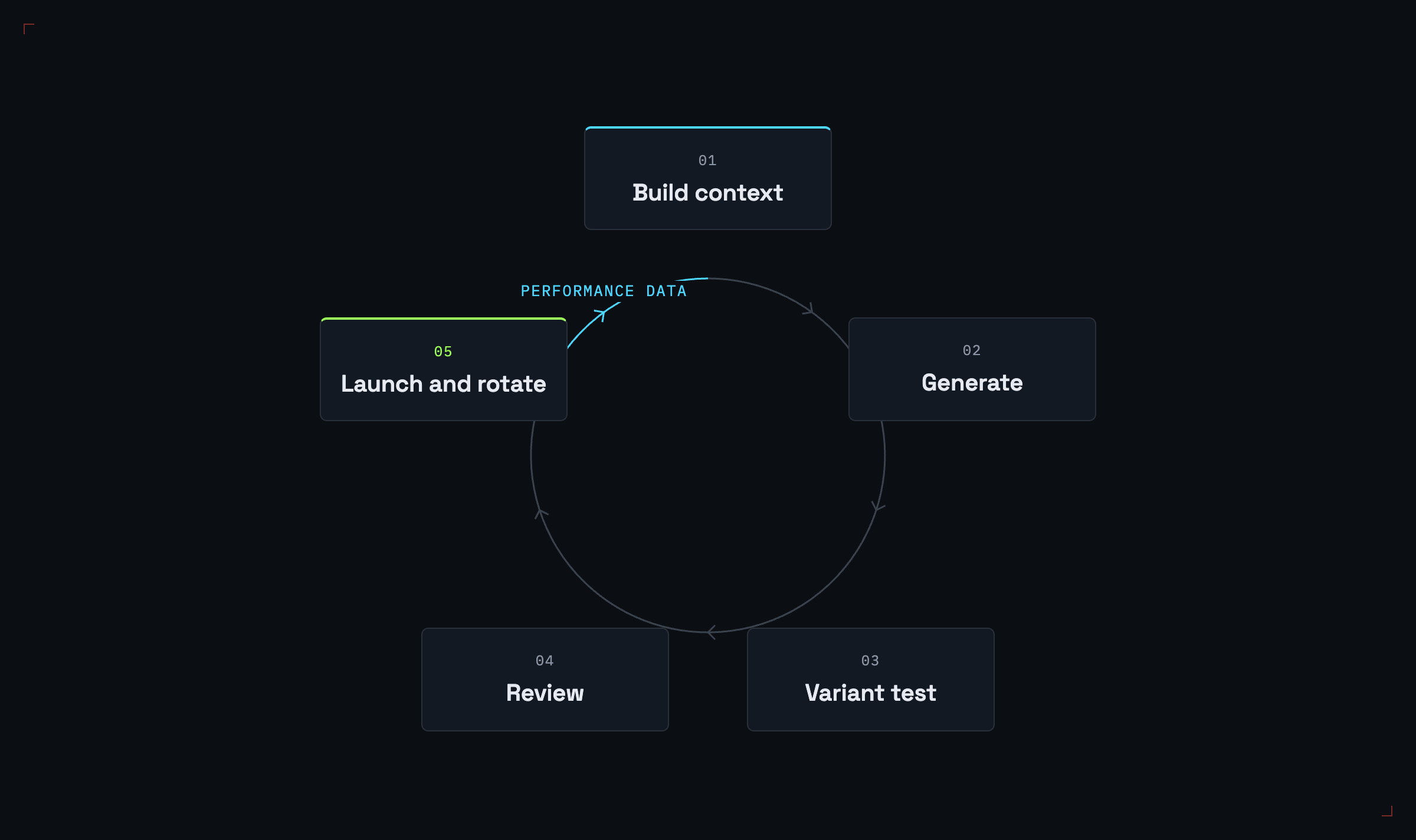
The Workflow: Generate, Test, and Scale AI Ad Copy in 5 Steps
This is the loop we recommend running end to end. The steps stay the same whether you run them across a stack of tools or inside one platform.
Step 1: Build Campaign Context
Before you generate a single headline, write the brief the model works from: the product, the target audience, the core USPs, and the brand voice as two or three concrete rules ("plain verbs, no exclamation points, lead with the outcome"). Vague context produces vague copy, and the more specific the input, the less editing you do downstream.
Step 2: Generate Platform-Specific Copy
Generate against each platform's format rather than writing once and reshaping later. A Google responsive search ad needs short, keyword-aligned headlines; a Meta primary-text block can run longer and more conversational; LinkedIn skews professional. This is where a platform that generates ad copy to each network's spec in one pass saves the most time. Tools like Jasper or Copy.ai are strong at the writing itself, so the distinction here is generating to spec for several platforms at once.
Step 3: Produce Headline and Description Variants
For each platform, generate a spread of variants rather than one "best" option. Google gives you room to do this: a single responsive search ad accepts up to 15 headlines and 4 descriptions, then assembles and tests combinations to learn which perform best over time. More headlines alone don't guarantee better results, though. The key is relevant, non-duplicative copy that follows policy and gives the system meaningful combinations to learn from, so aim for genuine variety in hooks, angles, and CTAs rather than near-duplicate phrasing.
Step 4: Review, Refine, and Approve
AI does the drafting, but a human still makes the call on what ships. Read every variant for factual accuracy, brand fit, and the claims your legal team would flinch at, then cut the bland middle: models regress toward safe phrasing, so kill the variants that read like everyone else's ad and keep the ones with a real angle.
Step 5: Launch, Measure, and Rotate
Push the approved set live, then let performance data decide what survives: watch CTR and conversion rate per variant, retire the laggards, scale the winners. Don't call a winner or a loser off one day of noisy CTR. Set minimum impression, click, and conversion thresholds before you judge a variant, account for conversion lag, and hold a cooldown window before you rotate anything out. Closing this loop means tying copy performance to real outcomes, which is where multi-touch attribution earns its place: it credits touchpoints across a journey instead of handing everything to the last click, though it assigns credit rather than proving causal lift. For major budget calls, pair it with incrementality tests or holdouts where you can run them. Our autonomous agents can run this rotation continuously in real time or near-real-time where platform data and APIs allow, adjusting bids on live data and pausing underperformers when CPA crosses a threshold you set.
Writing Prompts That Produce High-Converting Copy
A good prompt does the work of a good brief. The pattern that consistently produces usable variants names the audience, the pain point, the angle, and the constraint in one instruction. Something like: "Write 8 Google RSA headlines (max 30 characters) for time-strapped PPC managers. Lead with the time saved, vary the psychological angle across the set, and include one with keyword insertion for 'ad copy.'" Treat that keyword-insertion line as a template, not a finished ad: dynamic keyword insertion can render awkward or misleading copy when the keyword list is broad, so preview each combination and keep the keyword set tightly controlled.
Two habits separate prompts that scale. Ask for a set with deliberate variety rather than a single answer, so you get testable spread in one shot. And bake the constraints into the prompt itself, the character limit and the CTA style, so you edit the prompt once instead of every line that comes back.
Platform-Specific Requirements (Character Limits Cheat Sheet)
Every platform enforces its own format, and a variant that fits one can overflow another. Google's limits below are hard validation limits, from Google's own documentation. Meta publishes hard maximums for text length rather than a single recommended count; TikTok and LinkedIn publish theirs as recommended, placement-dependent guidance instead of one hard rule. They all change, so treat the table as a starting checklist and confirm against the live ad builder before you ship.
| Platform | Format | Headline limit | Description / body limit | Key requirement |
|---|---|---|---|---|
| Google Ads | Responsive search ad | Up to 15 headlines, 30 chars each | Up to 4 descriptions, 90 chars each | Google assembles and tests combinations; more distinct, relevant headlines give it more to learn from |
| Meta (Facebook Feed) | Image ad | No single fixed headline count; shorter headlines preview more reliably | Primary text up to 1,024 characters, title/description up to 255 characters (Meta Marketing API maximums) | These are API maximums, not recommended lengths; text well under the cap still previews more cleanly depending on placement |
| TikTok | In-feed video ad | Visual-first; copy is secondary | Confirm the current Ads Manager text limit for the selected format | Video is typically 5 to 60 seconds and must use an accepted aspect ratio with audio; other formats, placements, and objectives carry their own specs |
| Sponsored Content (single image) | \~70 characters before truncation | Intro text \~150 characters before truncation | Recommended guidance to avoid truncation in feed; confirm current limits in Campaign Manager |
Google's responsive search ad is the most generous on text, which is why it suits a variant-heavy workflow. Meta's Marketing API sets generous maximums for title, description, and body text, but copy well under those caps still previews more reliably depending on placement, and TikTok treats copy as a supporting layer to a 5-to-60-second video. LinkedIn's single image ad specs sit in between, and the other networks each add their own rules, which is exactly why managing limits by hand across a stack does not scale.
How Synter Creative Engine Scales Copy + Execution in One Workflow
Standalone copy tools solve the writing step and hand you a file to download, reformat, and upload to each ad account by hand. We built Synter to close that gap: Synter Creative Engine generates the copy for 27 platforms in the format each network expects, and the Campaign IDE pushes approved changes straight to your live ad accounts, so the brief-to-live path stays inside the software instead of a separate export-and-upload step, which is the practical difference between a writing tool and an operator.
Two capabilities matter most for a variant-heavy program. We automate the creative side and run multi-armed bandit testing with fatigue detection and automatic rotation, so winners get budget and stale variants get swapped without a manual audit. Because that testing feeds back into attribution and bidding, performance data informs the next round of generation instead of dying in a spreadsheet.
There's a real trade-off here: you connect each ad platform once before the loop runs hands-off, which is setup time you pay up front. For a team shipping variants across several platforms a week, that one-time connection beats the recurring upload tax.
Common Mistakes When Scaling AI Ad Copy
A reliable way to waste an AI workflow is to scale the wrong things. A few patterns show up again and again:
- Generating near-identical variants. Fifteen headlines that say the same thing in different word order teach the algorithm very little. Vary the angle, not just the phrasing.
- Skipping the human review layer. Models can confidently produce a claim you can't back up. Step 4 is not optional.
- Letting brand voice drift. Without explicit voice rules in the brief, output trends toward generic. Encode the voice once, in the prompt.
- Ignoring fatigue. A winning variant decays. If nothing rotates it out on a schedule, your best ad slowly becomes your worst.
- Testing copy without closing the loop. If you can't tie a variant to a real conversion, you're optimizing for clicks, not revenue.
Human creativity still sets the strategy: AI handles the volume, and you decide what's worth scaling.
Frequently Asked Questions
Which AI is best for ad copy?
There's no single winner. Dedicated writing tools like Jasper, Copy.ai, and Anyword are strong at drafting. If your bottleneck is distribution and testing across platforms rather than the writing itself, an operator that generates and executes, like Synter, fits the workflow better. Match the tool to where you actually lose time.
What is AI ad copy?
It's headline, description, and CTA text for paid ads, drafted by a large language model from a campaign brief, then reviewed by a human before it runs.
Is it legal to use AI for ads? Is AI copywriting illegal?
Using AI to draft ad copy is legal on the major platforms, and AI copywriting itself isn't illegal. The usual standards still apply, and you're accountable for what runs under your account, exactly as with human-written copy. Build your review step around specific areas: substantiation for any claim you make, price and promo accuracy, trademark and IP use, restrictions on regulated categories, each platform's ad policies, and jurisdiction-specific disclosures. Keep a human approval step. (This isn't legal advice; check your platform policies and local regulations.)
Conclusion
Writing ad copy stopped being the real constraint a while ago. Generating variety, shipping it to every platform in spec, and rotating it on performance data is the work that scales, or doesn't. Treat it as a workflow: build context once, generate per platform, produce real variants, keep a human in the loop, then launch and rotate on data.
If you'd rather run that full generate-test-rotate loop in one place instead of stitching tools together, SOLO starts at $20 per month or $200 per year, with claimable monthly credits included. Wire up your accounts once, and let the loop run.