Most coverage of agentic AI marketing throws every "AI agent" into one bucket, and that's a problem the moment you're the person signing the contract. A platform whose agents orchestrate customer journeys solves a completely different problem than one whose agents log into your ad accounts and move budget at 2 a.m. Both market themselves as agentic AI marketing platforms. Only one fixes your actual bottleneck.
This guide is for performance marketers, growth leads, and agency operators deciding whether to adopt an agentic platform and, if so, which one. We'll define the category, separate the CRM and content suites from the ad-execution operators, and put seven platforms side by side so you can match the agent to the work it really does. We build Synter in the ad-execution category, so we'll be straight about where the broad suites win and where they leave money on the table.
What Is Agentic AI Marketing?
Agentic AI marketing is the use of semi- or fully autonomous AI systems that perceive campaign conditions, reason about what to do next, and can plan and select actions, executing some steps within the goals and guardrails you set. MIT Sloan describes agentic AI as "a new breed of AI systems that are semi- or fully autonomous and thus able to perceive, reason, and act on their own". In marketing, that means software that doesn't just draft an email when prompted but decides the audience, schedules the send, watches the response, and adjusts, all inside guardrails you define.
The shift is real enough that analysts are already warning buyers to separate substance from hype. Gartner expects over 40% of agentic AI projects to be canceled by the end of 2027, citing escalating costs, unclear business value, and inadequate risk controls. Picking the right kind of agent—and defining the operating guardrails before rollout—is how you avoid that failure mode.
Agentic AI vs. Generative AI vs. Traditional Automation
These three terms get swapped around constantly, and they shouldn't be. Traditional automation follows rules you write in advance: if cost-per-click crosses a threshold, lower the bid. It's reactive and deterministic, nothing more. Generative AI produces content on demand: an ad headline, an image, a landing-page draft, then stops the moment the output is delivered. It responds to prompts, but it doesn't pursue a goal on its own.
Agentic AI is the proactive layer on top. It's goal-driven rather than prompt-driven. You hand it an objective ("hit 4x ROAS on this product line across paid social"), and the system reads performance data, weighs trade-offs, and takes autonomous action across whatever surfaces it controls. MIT Sloan frames this class of AI as software that can "complete tasks independently or with minimal human supervision", which is the line generative tools never cross on their own.
A quick way to keep them straight:
- Traditional automation: rules you set, firing when conditions are met. No judgment.
- Generative AI: you prompt, it creates, it waits. No follow-through.
- Agentic AI: you set a goal and guardrails, it decides and acts, then reports back.
Why the difference matters for ad operations
In paid media, the distinction stops being academic fast. Google's Smart Bidding and Performance Max automate bidding well, but they optimize inside one platform's walls and inside the rules that platform allows. A generative tool spins up two dozen creative variants and then sits there waiting. An agentic system is the only one of the three that can look across Google, Meta, and TikTok at once, notice that Meta is burning budget at a worse ROAS than Google, and shift spend between them, because that decision lives between platforms, not inside any single one. That cross-account judgment is the work agentic platforms are built to do, and it's the reason the category exists at all.
How Agentic AI Marketing Platforms Work
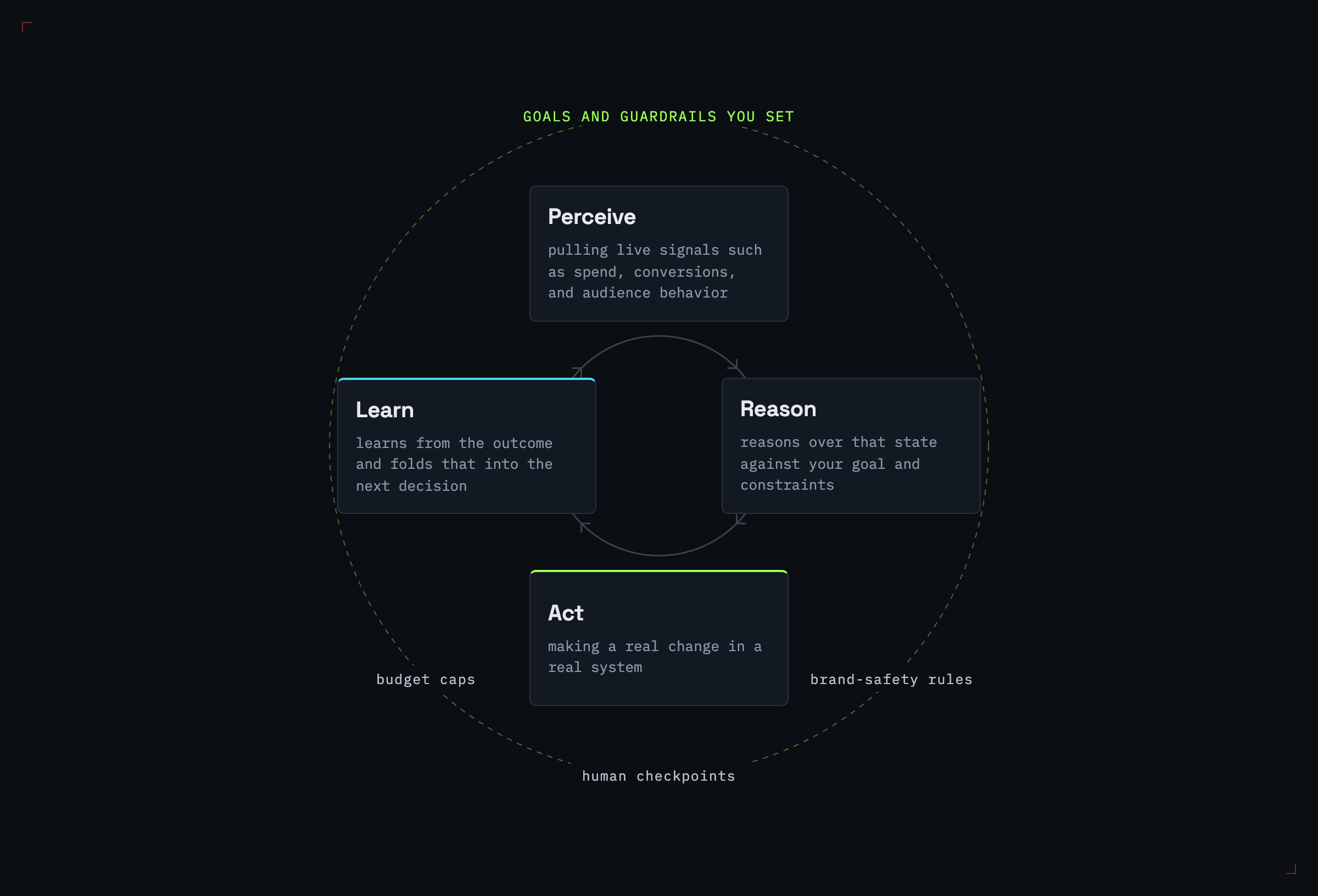
Under the hood, agentic platforms run a loop that's easy to describe and much harder to execute well: perceive, reason, act, learn. The agent perceives by pulling live signals such as spend, conversions, and audience behavior. It reasons over that state against your goal and constraints. It acts by making a real change in a real system. Then it learns from the outcome and folds that into the next decision. The loop repeats continuously or on frequent intervals where the data and APIs allow, rather than on a human's review cadence.
What separates platforms is where in your stack the loop runs and how much autonomy you grant it. A useful mental model is levels of autonomy: assistive (it suggests, you do), knowledge (it answers questions about your data), action (it executes approved changes), and multi-agent (specialized agents coordinate on a larger objective). Most credible platforms let you dial this up gradually instead of handing over the keys on day one, which is exactly how you should want it.
The other thing that makes the loop work is connectivity. An agent can only act where it has authenticated, read-write access, which is why the protocol layer matters more than it sounds. We expose, as one example, a unified MCP and REST interface to read, write, and execute across 27 ad platforms from one connection, built on the Model Context Protocol, an open-source standard "for connecting AI applications to external systems". Connect once, and the agents operate everywhere you advertise rather than living inside a single dashboard. MCP is the connective layer, though, not the ad-platform integration itself: what an agent can actually do inside Google Ads or Meta still depends on that platform's own API, the OAuth scopes and permissions you grant it, which write operations the platform supports, and its rate limits. If you run paid search specifically, the same connectivity logic applies to an AI agent for Google Ads: the agent is only as useful as the accounts it can actually reach and change.
What to Look For in an Agentic AI Marketing Platform
Because "agentic" now shows up on nearly every marketing tool's homepage, the useful questions are about substance, not the label. Gartner has a name for the underlying problem: "agent washing," rebranding existing automation or chatbot tools as agentic without the autonomy to back it up. Five criteria separate a real agentic platform from a generative feature wearing a costume:
- Autonomy with guardrails. Can it act without you approving each step, and can you bound that action with budget caps, brand-safety rules, and human checkpoints? Both halves matter; autonomy without limits is a liability, and limits without autonomy is just a dashboard.
- Goal orientation. Do you give it an objective (target ROAS, CPA ceiling) or a task list? Goal-driven beats task-driven for agentic work, because the whole point is letting the system choose the path.
- Integrations and reach. Where can the agent actually act? A loop that only touches one platform can't make cross-platform decisions. This is where the AI ad management platforms question really lands: breadth of connected accounts is the ceiling on what any agent can do.
- Multi-agent coordination and scalability. Can specialized agents for creative, bidding, and reporting work in parallel without stepping on each other?
- Attribution and feedback. The loop only learns if it sees outcomes. Native multi-touch attribution that stitches ad clicks to revenue is what lets the agent optimize for the metric you actually care about, not the platform's in-house proxy for it. Attribution assigns credit, though; it doesn't prove incrementality, so holdout tests, geo experiments, or other clean causal methods still matter when you need proof, not just correlation.
Run any vendor through those five, and the marketing copy falls away quickly. The platform either grants real autonomy across a real footprint with a real feedback loop, or it's a generative tool with an agent sticker on the box.
The Best Agentic AI Marketing Platforms Compared (2026)
The framing that actually helps buyers: agentic AI marketing isn't one market. The platforms below split cleanly into two groups that solve different problems. The suites orchestrate customer journeys, content, and CRM. The ad-execution operators run the paid-media accounts. Comparing them on a single "best" axis is a category error, so the table below compares them on what their agents actually do instead.
| Platform | Primary focus | Autonomy level | Channels / integrations | Best for |
|---|---|---|---|---|
| Adobe (Agent Orchestrator) | Enterprise customer-experience orchestration | Multi-agent, supervised | Adobe Experience Platform; content, journeys, audiences | Large enterprises standardized on Adobe |
| Salesforce Agentforce | CRM-anchored agents (service, sales, marketing) | Action, within guardrails | Salesforce CRM and Data Cloud; customer channels | Teams running on Salesforce CRM |
| Braze | Cross-channel customer engagement | Action and decisioning | Email, mobile, web, SMS, WhatsApp | Lifecycle and messaging teams |
| Optimove | Customer-led / retention marketing | Decisioning and orchestration | Email, SMS, mobile, web, ad networks | Retention-heavy verticals |
| Writer | Enterprise agentic content and work | Build-your-own agents | Cross-functional enterprise workflows | Content ops at large enterprises |
| Amazon Ads (agentic) | Ad creation / optimization in Amazon's ecosystem | Action, Amazon-scoped | Amazon Ads, Amazon Marketing Cloud | Brands concentrated on Amazon |
| Synter | Cross-platform ad-execution operator | Action and autonomous 24/7 | 27 ad platforms via MCP and REST | Multi-platform paid-media teams and agencies |
Agentic suites for CRM, journeys, and content (Adobe, Salesforce, Braze, Optimove, Writer)
These platforms aim their agents at the customer relationship and the content that feeds it. Adobe's Experience Platform Agent Orchestrator coordinates a set of agents across planning, audiences, content, journeys, and delivery for enterprises standardized on its stack. Salesforce Agentforce anchors its agents in CRM data and acts within set guardrails across service, sales, and marketing. Braze runs agents for cross-channel engagement across email, mobile, web, and messaging; Optimove points its agents at retention and lifecycle orchestration; Writer lets enterprises build their own agents on top of company knowledge, with marketing as one use case among many.
If your bottleneck is lifecycle messaging, journey design, or content production at scale, a suite is the right call, and our platform doesn't replace it. What these suites generally don't do is operate your paid-media accounts across platforms. Their agents optimize the journey and the message rather than sitting inside Google Ads and Meta moving bids and budget around.
Agentic platforms for ad execution (Synter, Amazon Ads)
This is the other half of the category, where the agent's job is to operate the ad accounts directly. Amazon's agentic ads tooling does this inside one ecosystem: it helps plan, create, and optimize campaigns at scale within Amazon Ads and Amazon Marketing Cloud. The constraint is scope. It runs Amazon, not your full cross-channel advertising footprint.
We built Synter for the cross-platform case. It's the AI Agent Operator for Ads: our agents connect once through a unified MCP and REST interface, then read, write, and execute across 27 ad platforms. You can drive them yourself in a chat-first Campaign IDE with 40+ agent skills, or set goals and guardrails and let them run autonomously, adjusting bids on real-time performance data, pausing underperformers when CPA exceeds your thresholds, and reallocating budget across platforms using validated performance signals. To be clear about scope: we don't do CRM journeys or lifecycle messaging. Synter operates the ad accounts, which is exactly the work the suites leave on the table.
Benefits and Risks of Agentic AI in Marketing
The upside is straightforward when the fit is right. Agents deliver personalization at scale and real-time decisions a human team would struggle to match around the clock; they free marketers from tab-switching and spreadsheet reconciliation, and on the ad side they can pursue automated ad optimization goals like ROAS continuously rather than only during business hours. The promise is simple: the marketer stops doing the clicking and starts directing the strategy.
The risks are just as real, and pretending otherwise is how teams end up in Gartner's cancellation column. More decisions made autonomously means more decisions made without a human in the moment, which raises the stakes on bias, data privacy, brand-voice drift, and explainability. An agent reallocating six figures of budget needs an audit trail and a reason you can inspect, not a black box you have to trust on faith. In practice, that means daily budget-change caps, cooldown periods between large moves, approval gates above a set threshold, rollback records, and alerts the moment tracking breaks.
This is where governance frameworks earn their place. The NIST AI Risk Management Framework is "intended for voluntary use and to improve the ability to incorporate trustworthiness considerations in the design, development, use and evaluation of AI systems", and it's a sensible starting point for the controls you'll want around any autonomous system. In practice, that means insisting on guardrails, budget caps, scoped access, and a log of every action the agent took. Review each vendor's current security documentation—including Synter's security controls—before granting an agent write access.
How to Get Started with Agentic AI Marketing
Don't hand an agent your whole budget on day one. The teams that get value treat adoption as crawl-walk-run, starting with a contained problem and a hard budget cap, then widening the mandate as the agent earns trust. A workable sequence looks like this:
- Get the data foundation right. Agents are only as good as the signals they see. Connect your ad accounts, analytics, and CRM so the loop perceives real outcomes instead of partial ones.
- Pilot on one objective. Pick a single goal, like a CPA ceiling on one product line, and let the agent run it with human checkpoints. Watch what it changes and why.
- Set guardrails before you scale autonomy. Budget limits, brand-safety rules, and approval gates come first. Autonomy then expands into the space those rules define.
- Shift your own role to orchestrator. The marketer's job moves from executing changes to directing agents and auditing their decisions, and that role shift is the real transformation, more than any single feature.
For ad operations specifically, the chat-first model helps here: you can ask an agent what it changed and why, read the reasoning, and approve or roll back, all before you ever turn on full autonomy. An agent that explains its bid changes in plain language is a far lower-risk on-ramp than one that just acts silently and emails you a chart at the end of the week.
Frequently Asked Questions
How is agentic AI used in marketing?
Agentic AI runs goal-driven marketing tasks autonomously: managing customer journeys, generating and testing creative, and on the paid-media side, adjusting bids, pausing underperformers, and reallocating budget across platforms by ROAS, all inside guardrails the marketer sets. The agent perceives performance data, decides, and acts in real time instead of waiting for manual input at every step.
What are examples of agentic AI?
In marketing specifically, examples include CRM and journey suites like Adobe's Agent Orchestrator and Salesforce Agentforce, engagement platforms like Braze and Optimove, enterprise content-agent platforms like Writer, and ad-execution operators like Amazon's agentic ads tooling (within its own ecosystem) and Synter (across 27 ad platforms). Each runs autonomous agents, but aimed at different parts of the funnel.
What is the course of agentic AI marketing?
The trajectory points toward more decisions made autonomously and the marketer's role shifting from operator to orchestrator. Expect agentic features to become more common as vendors move from recommendation-only copilots toward bounded execution.
What is an agentic AI strategy?
An agentic AI strategy is a deliberate plan for where you grant agents autonomy, what guardrails bound them, and how you measure their decisions. It starts with a clean data foundation and a contained pilot, sets budget and brand-safety limits before scaling, and redefines the team's job around directing and auditing agents rather than doing the manual work by hand.
Conclusion
"Agentic AI marketing" isn't really a single category you pick a winner from; in practice it splits into two: agents that orchestrate journeys, content, and CRM, and agents that operate the ad accounts. The right platform is the one whose agents act where your bottleneck actually sits. If that bottleneck is lifecycle messaging or content, a suite fits. If it's buying and optimizing paid media across many platforms, an ad-execution operator is the tool for the job.
If your team lives in paid media across more than one platform, that's the case we built Synter for. You can review the current plans or book a demo to see the workflow against your own accounts before you commit ad spend.